
Busan is the kind of city that surprises first-time visitors. People come expecting a smaller, slower version of Seoul and instead find a port city with its own dialect, its own food culture, and a coastline that completely shapes the rhythm of daily life. After walking this exact route multiple times with friends visiting from overseas, I’ve put together what I think is the most efficient way to see the essentials in 1 night and 2 days — without spending half your trip on transit.
The key to making this work is geography. Busan’s must-see attractions cluster in two distinct zones: the historic downtown around Nampo-dong (markets, alleys, the painted hillside village) and the modern Haeundae district (beach, observation deck, coastal trail). Bouncing between them wastes hours. So this itinerary keeps Day 1 entirely in the downtown core and shifts to Haeundae for Day 2 — which also means you only change hotels once, or not at all if you base yourself in Haeundae from the start.

QUICK FACTS BEFORE YOU GO
Getting to Busan from Seoul: KTX from Seoul Station, ~2h 40min, ₩59,800 (~$44 USD)
Best months to visit: April–June and September–October (mild weather, no monsoon)
Currency: Korean Won (KRW). $1 ≈ ₩1,360
Language: English signage at major attractions; less common in markets
Transit card: Buy a T-money card at any convenience store (₩4,000 + load value)
Power outlets: 220V, Type C/F (European-style two-pin plug)
Day 1: Downtown Busan — Markets, Alleys & Sunset on the Hill
Day 1 is concentrated around Jung-gu (Central District). Almost everything is walkable, with one short taxi ride at the end to reach Gamcheon Culture Village in time for sunset. Wear comfortable shoes — you’ll cover roughly 8–10 kilometers on foot.
Stop 1 · Jagalchi Market — Korea’s Largest Seafood Market
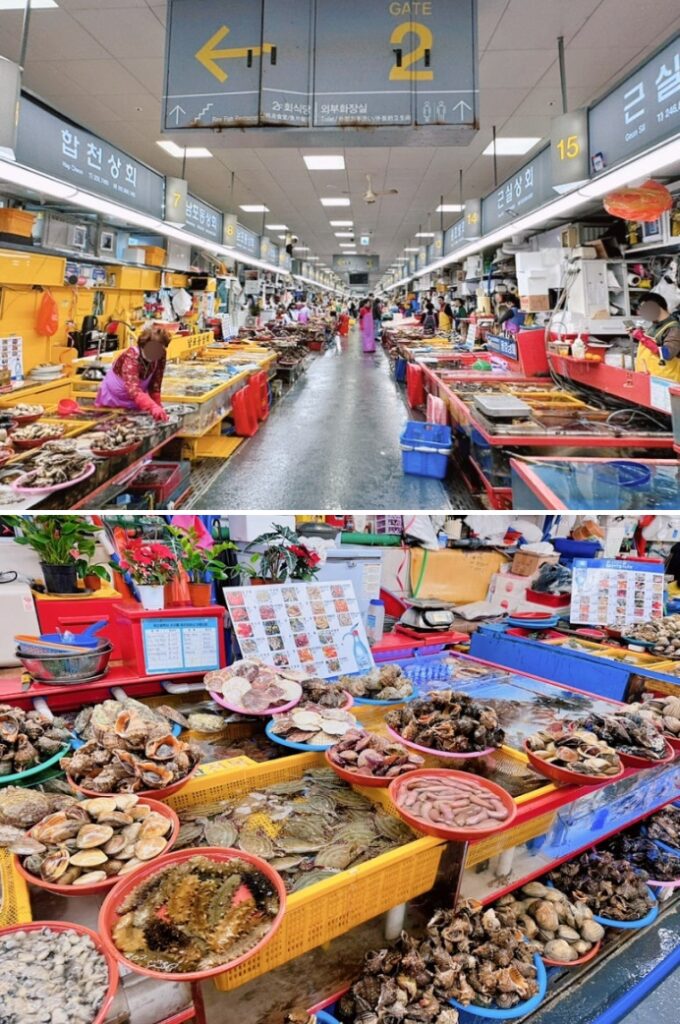
Start your morning at Jagalchi Market, the country’s largest seafood market and the single most “Busan” experience you can have in one place. The main building is a modern two-story structure on the waterfront, but the real atmosphere is in the narrow lanes outside, where the famous “Jagalchi ajummas” (older female vendors) sell everything from live octopus to grilled mackerel. Many of these women are second- or third-generation traders.
If you want to actually eat here, the system is simple: pick your seafood from a vendor on the first floor, pay for it, then take it upstairs where a restaurant will prepare it any way you like — sashimi, grilled, or in a spicy stew — for a small cooking fee, usually ₩5,000–10,000 ($4–7 USD) per person. A meal of fresh sashimi for two typically runs ₩40,000–60,000 ($30–45 USD). More expensive than a regular restaurant, but you’re paying for fish that was alive an hour ago.
Address: 52 Jagalchihaean-ro, Jung-gu, Busan
Hours: 5:00 AM – 10:00 PM (restaurants from 9:00 AM)
Closed: 1st and 3rd Tuesdays of each month
Admission: Free (meals ₩20,000–40,000 / $14–28 USD per person)
Subway: Jagalchi Station (Line 1), Exit 10 — 2-minute walk
Tip: Bring some cash. Most ground-floor seafood vendors don’t accept cards.
Stop 2 · BIFF Square — Street Food & Film History
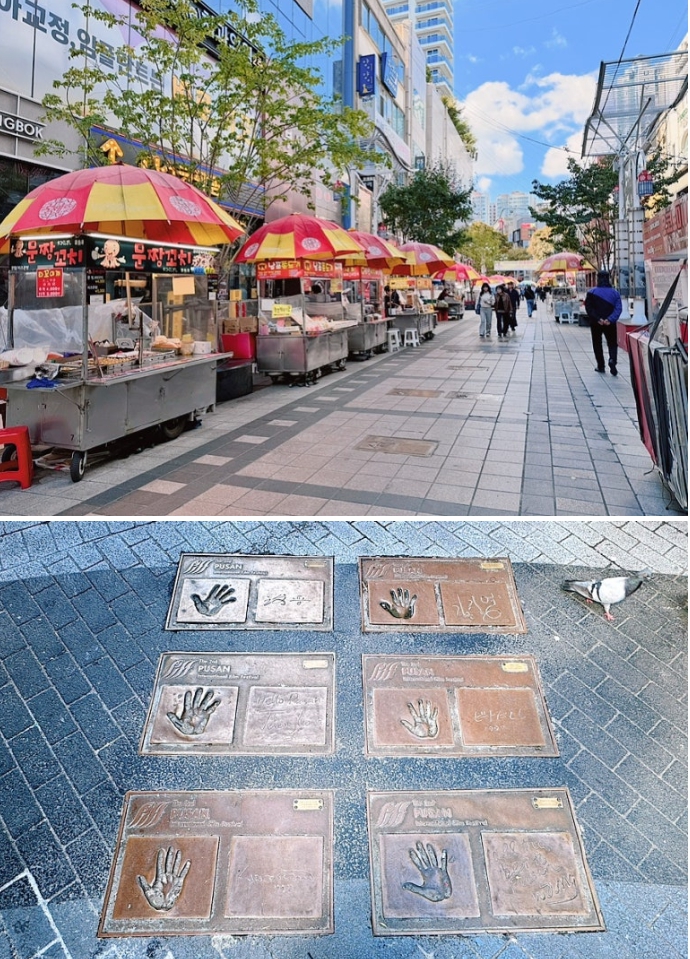
A 5-minute walk north from Jagalchi takes you to BIFF Square, named after the Busan International Film Festival that launched here in 1996. You’ll spot handprints of Korean and international actors set into the pavement, but most visitors come for one specific snack: ssiat hotteok (씨앗호떡), the seed-stuffed sweet pancake that Busan invented.
A regular hotteok is a fried sweet pancake filled with brown sugar syrup. The Busan version cuts it open after frying and stuffs it with a mix of sunflower seeds, peanuts, and pumpkin seeds — hot, sweet, crunchy. At ₩2,000 (~$1.50 USD), it’s one of the few street snacks I’d actively recommend going out of your way for. Two or three competing stalls operate here; they all taste roughly the same, so just join the shorter line.
Other snacks worth trying around the square: bibim dangmyeon (cold mixed glass noodles, ₩4,000), chungmu gimbap (mini rice rolls served with spicy squid, ₩6,000), and eomuk (Busan-style fish cake skewers, ₩1,000–2,000 each). Eomuk is genuinely a Busan specialty — better here than anywhere else in Korea.
Address: Around 20 BIFF Gwangjang-ro, Jung-gu, Busan
Hours: Street stalls roughly 11:00 AM – 11:00 PM
Subway: Jagalchi Station (Line 1), Exit 7 — 3-minute walk
Budget: ₩10,000–15,000 ($7–11 USD) for a good sampling
Stop 3 · Gukje Market & Bupyeong Kkangtong Market
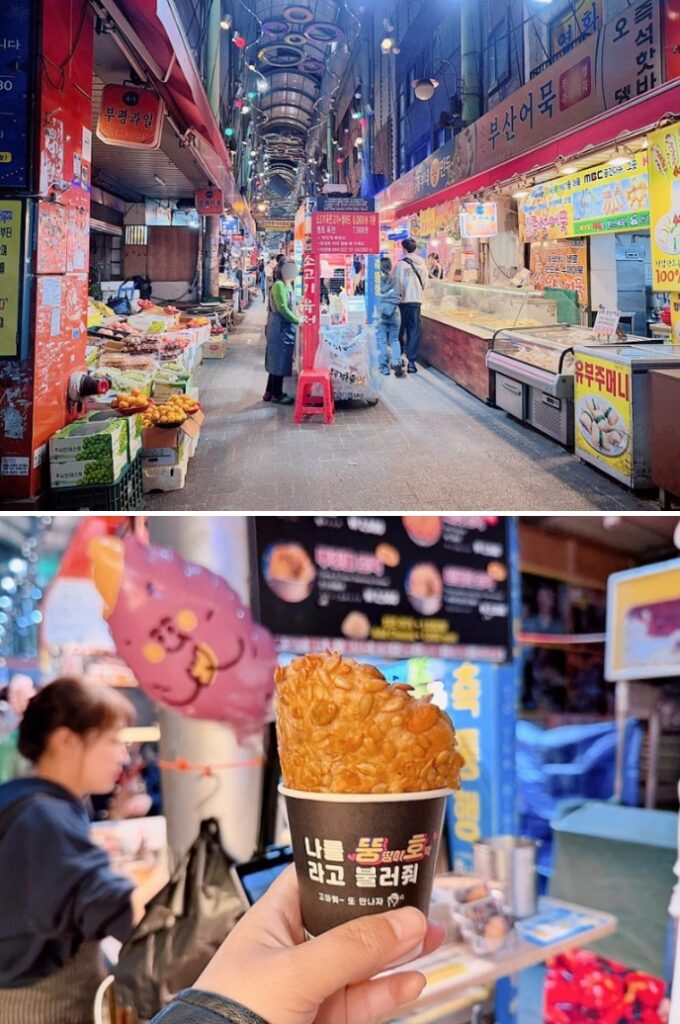
Continuing on foot, you’ll hit two more historic markets within a few blocks of each other. Gukje Market (“International Market”) was founded after the Korean War by refugees and traders, and today it’s a sprawling maze of stalls selling clothing, kitchenware, cosmetics, and imported goods — particularly Japanese products, given Busan’s proximity to Fukuoka.
Right next door is Bupyeong Kkangtong Market, also called the “Tin Can Market” because it originally specialized in canned goods smuggled in after the war. Today it’s known mainly for its night market — from around 7:30 PM to midnight, the central aisle fills with food stalls selling everything from Vietnamese spring rolls to Mongolian dumplings to fresh pajeon (Korean savory pancakes). If your route can be timed to be here in the early evening, the night market is one of the best food experiences in the city.
In between, take a 10-minute walk to Bosu-dong Book Alley, a narrow lane lined with secondhand bookshops, some operating since the 1950s. Even if you can’t read Korean, the alley itself is photogenic — stacks of yellowing paperbacks spilling onto the street, hand-painted shop signs, the occasional cat. Worth a 20-minute detour.
Gukje Market: 9:00 AM – 8:00 PM (closed 1st and 3rd Sunday)
Bupyeong Night Market: 7:30 PM – 12:00 AM (Friday–Sunday is busiest)
Subway: Jagalchi Station (Line 1), Exit 3 or 7 — 8-minute walk
Tip: Prices are negotiable in Gukje for non-food items. Start at about 70% of the asking price.
Stop 4 · Gamcheon Culture Village at Sunset
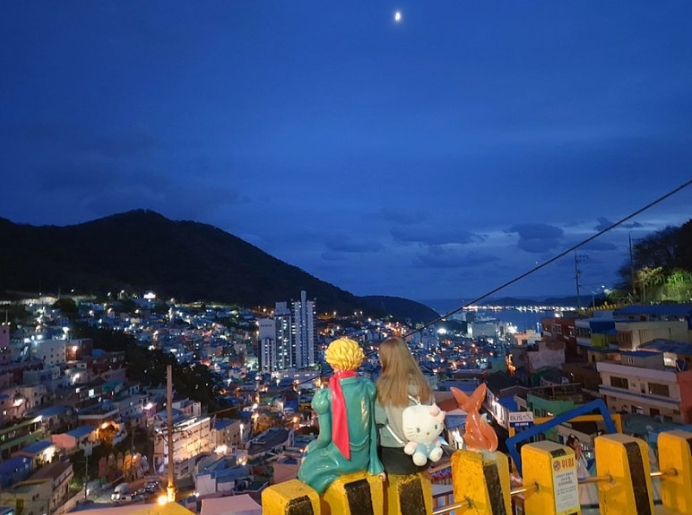
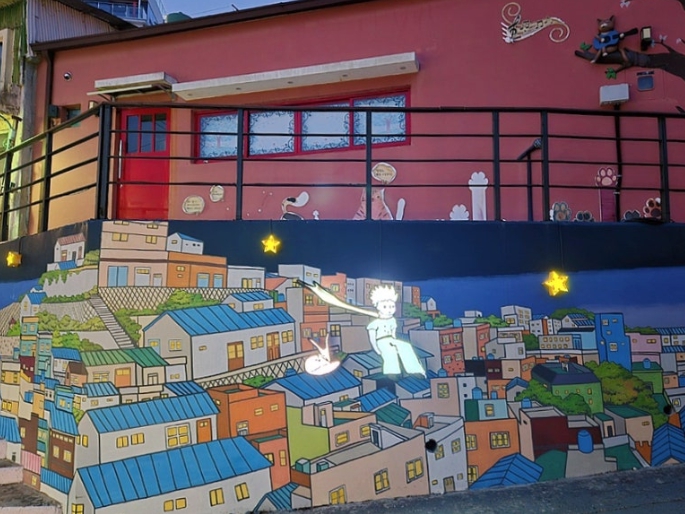
From the Nampo-dong area, take a taxi (about 15 minutes, ₩10,000–15,000) or local bus (Saha 1, Saha 1-1, or Seo-gu 2 from Toseong Station Exit 6) up to Gamcheon Culture Village. This is the famous painted hillside village often called “Korea’s Machu Picchu” or “Korea’s Santorini.” Neither comparison is quite right, but the visual impact of the brightly colored houses cascading down the mountainside is striking, especially in late afternoon when shadows lengthen across the rooftops.
The village has a complicated history. It was originally built by refugees during the Korean War, and for decades it was one of the poorest neighborhoods in Busan. In 2009, the city collaborated with local artists and residents to repaint the houses and install public art, transforming it into the cultural landmark it is today. About 8,000 people still live here, so be respectful — don’t enter homes, keep your voice down, and don’t photograph residents without permission. Signs throughout the village remind visitors of this.
Most visitors come for two photo spots: the panoramic view from the wooden observation deck near the entrance, and the Little Prince statue, where you can sit next to the small bronze figure and his fox with the entire village spread out behind you. The line for the Little Prince photo can be 20+ minutes during peak hours, but it moves quickly.
I’d specifically recommend arriving about 90 minutes before sunset. Golden hour light makes the colored buildings glow, and as it gets darker, lights come on across the hillside. The village officially closes at 6:00 PM (some shops close earlier), but the streets remain accessible afterward.
Address: 203 Gamnae 2-ro, Saha-gu, Busan
Hours: Streets open 24/7; shops 9:00 AM – 6:00 PM (5:00 PM Nov–Feb)
Admission: Free (optional stamp trail map ₩2,000 / ~$1.50 USD)
Getting there: Taxi from Nampo-dong (₩10,000–15,000) or Bus 2/2-2 from Toseong Station Exit 6
What to wear: Comfortable shoes — the village is built on a steep hill with many stairs
For dinner, head back down to Nampo-dong (taxi ₩6,000) and try dwaeji gukbap (pork-and-rice soup), Busan’s signature comfort food. A bowl runs ₩9,000–11,000 (~$7–8 USD). After dinner, take Subway Line 1 to Seomyeon, transfer to Line 2, and ride to Haeundae Station (about 50 minutes total, ₩1,500). If you booked your hotel near Haeundae Beach, you’ll be set up for an easy Day 2.
Day 2: Haeundae — Beach, Coastal Trail & Modern Busan
Day 2 shifts the energy completely. While Day 1 is dense, walkable, and food-focused, Day 2 is about open spaces, ocean views, and a slower pace. The whole day stays within Haeundae, with most stops accessible on foot from Haeundae Station.
Morning · Haeundae Beach & Dongbaek Island Trail
Haeundae is Korea’s most famous beach — a 1.5-kilometer crescent of pale sand framed by high-rise hotels and ringed by mountains. In summer (July–August) it’s packed shoulder-to-shoulder with parasols, but the rest of the year it’s surprisingly peaceful and great for a long walk. Even if you don’t swim, the beach is the natural starting point for the best part of Day 2: the coastal walk to Dongbaek Island.
Dongbaek Island isn’t actually an island anymore — it’s connected to the mainland — but it’s a small wooded peninsula at the western end of Haeundae Beach with a 2-kilometer wooden walking trail looping around the perimeter. The path takes you past the Nurimaru APEC House (a modern conference building used for the 2005 APEC summit), small lighthouses, and several spots where you can see the famous Gwangan Bridge in the distance. The full loop takes about 45 minutes at a leisurely pace and is one of the most underrated free experiences in Busan.
Before flying into Busan or transferring from Seoul, check our complete Korea travel tips for 2026 — SIM cards, T-money, Naver Map, and other practical essentials worth setting up before arrival.
Midday · Haeundae Blueline Park & Sky Capsule
If you want a uniquely Busan experience that didn’t exist a few years ago, this is it. The Haeundae Blueline Park is built on a former coastal railway line that was decommissioned in 2013. Today the route operates two attractions running side by side along the cliffs: the Beach Train (an open-air tourist train) and the Sky Capsule (small four-person elevated pods that glide above the coastline).
The Sky Capsule is the popular choice for couples and small groups — a private bubble with floor-to-ceiling windows looking out over the ocean. The downside is the price and the fact that you usually need to reserve in advance during weekends. The Beach Train is much cheaper and you can buy tickets on the spot. Most people do one direction in the Sky Capsule and walk back, which is the right approach in my opinion — the views are similar but the experience is more memorable.
Address: 30 Dalmaji-gil, Haeundae-gu, Busan
Hours: 9:30 AM – 6:30 PM (extended in summer)
Sky Capsule: ₩35,000–40,000 ($26–29 USD) for a 2-person capsule, one-way (prices per capsule)
Beach Train: ₩7,000 ($5 USD) one-way / ₩13,000 ($10 USD) day pass
Reservations: Strongly recommended on weekends — book through Klook or the official website
Afternoon · BUSAN X the SKY or Shinsegae Centum City
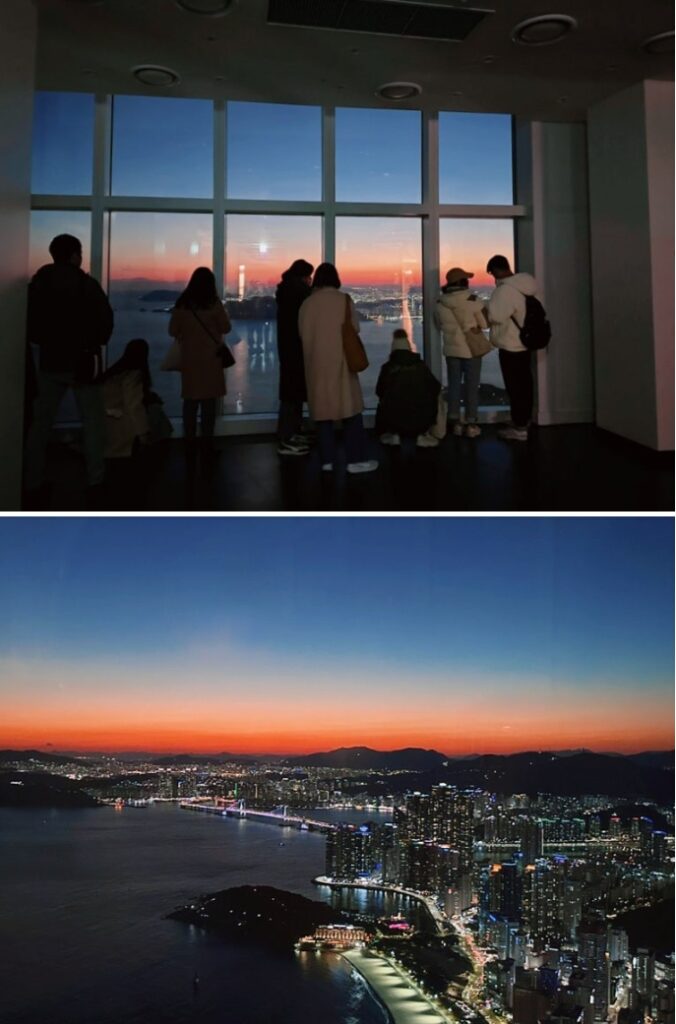
For your afternoon, choose based on weather. If it’s clear, head to BUSAN X the SKY, the observation deck on the 98th–100th floors of LCT Landmark Tower. The view sweeps from Haeundae Beach all the way to Gwangan Bridge, and on a clear day you can see Tsushima Island in Japan on the horizon. There’s a glass floor section that’s fun if you don’t mind heights, and a cafe on the top floor where you can sit with a drink and watch the city.
If the weather isn’t cooperating, Shinsegae Centum City is a 10-minute subway ride away and listed in the Guinness Book of Records as the world’s largest department store. Even if you don’t shop, the Spa Land jjimjilbang (Korean sauna) inside is one of the best in the country — clean, modern, with multiple themed rooms and outdoor foot baths.
Address: 30 Dalmaji-gil, Haeundae-gu, Busan
Hours: 10:00 AM – 9:00 PM (last entry 8:30 PM)
Price: Adult ₩27,000 ($20 USD) / Child ₩24,000 ($18 USD)
Tip: Best at sunset, when you get day, golden hour, and night views in one visit
Evening · Gwangalli Beach & Bridge Light Show
End your trip at Gwangalli Beach, a short taxi ride (15 minutes, ₩10,000) west of Haeundae. While Haeundae is the famous one, Gwangalli is where locals actually go in the evening — the beach faces the illuminated Gwangan Bridge, which puts on a free drone light show every Saturday night at 8:00 PM. Even on non-show nights, the bridge lights up beautifully and the beachfront is lined with bars and seafood restaurants.
For dinner, try milmyeon (Busan’s cold wheat noodles, lighter than naengmyeon) at a local spot, or grab fresh sashimi at one of the rooftop seafood restaurants facing the bridge. A sashimi platter with drinks for two runs about ₩60,000–80,000 ($45–60 USD).
Where to Stay in Busan for This Itinerary
For a 1-night stay, I’d recommend basing yourself in Haeundae rather than Nampo-dong. Reasons: more international hotel options, easier access to the airport via the airport limousine bus, better restaurant scene at night, and you wake up with the beach 5 minutes away on Day 2.
Three reliable options across budgets: Luxury — Park Hyatt Busan or Signiel Busan with ocean-view rooms from ₩400,000+ ($295+ USD) per night. Mid-range — Paradise Hotel Busan or Lavalse Hotel at ₩180,000–250,000 ($130–185 USD). Budget — guesthouses and 3-star hotels around Haeundae Station from ₩70,000–120,000 ($50–90 USD), many with private rooms and bathrooms.
Transportation, Money & Visitor Tips
T-money Card: Buy one at the airport, any convenience store, or subway machines. It works on all subways, buses, and most taxis. Reload at any subway station or convenience store.
Visit Busan Pass: A tourist pass available in 24-hour (₩55,000 / ~$40 USD) and 48-hour (₩85,000 / ~$62 USD) versions. Includes free entry to over 30 attractions plus transport benefits. Worth it if you plan to do BUSAN X the SKY, Sky Capsule, and at least one more paid attraction.
Cash: Most tourist areas accept Visa and Mastercard, but carry ₩50,000–100,000 ($35–75 USD) in cash for markets and street food.
Maps: Use Naver Map rather than Google Maps in Korea — Google’s walking and transit directions are unreliable here because of mapping restrictions. Naver Map has full English support.
Translation: Google Translate’s camera function works well for Korean menus and signs. Papago (made by Naver) is generally more accurate for Korean specifically.
Frequently Asked Questions
Is this itinerary suitable for first-time visitors to Korea?
Yes — it’s specifically designed for first-timers. The route uses clear subway lines, focuses on the most recognizable highlights, and avoids any logistically complicated stops. If it’s also your first time in Korea, I’d recommend spending 2–3 days in Seoul before or after.
How much does this 2-day trip cost in total?
Excluding hotels and flights: budget travelers can do it for ₩150,000–250,000 ($110–185 USD) per person across food, transport, and a couple of attractions. Adding the Sky Capsule and BUSAN X the SKY pushes it to ₩300,000+ ($220+ USD). A mid-range hotel adds another ₩200,000–300,000 ($150–225 USD) for the night.
Final Thoughts
This route packs a lot into 2 days, but the geographic logic — downtown on Day 1, Haeundae on Day 2 — keeps it from feeling rushed. You’ll come away with a real sense of why Busan feels different from Seoul: smaller, slower, more connected to the sea, with food culture that genuinely centers on what comes out of the water that morning.
If you have a third day to spare, I’d add either Beomeosa Temple (a major Buddhist temple in the mountains north of the city) or Taejongdae (a coastal park on Yeongdo Island with cliff views). But for a first visit on a tight schedule, the route above covers what makes Busan worth the trip.
Prices and operating hours verified as of April 2026. Always confirm directly with venues before visiting, as schedules change seasonally.