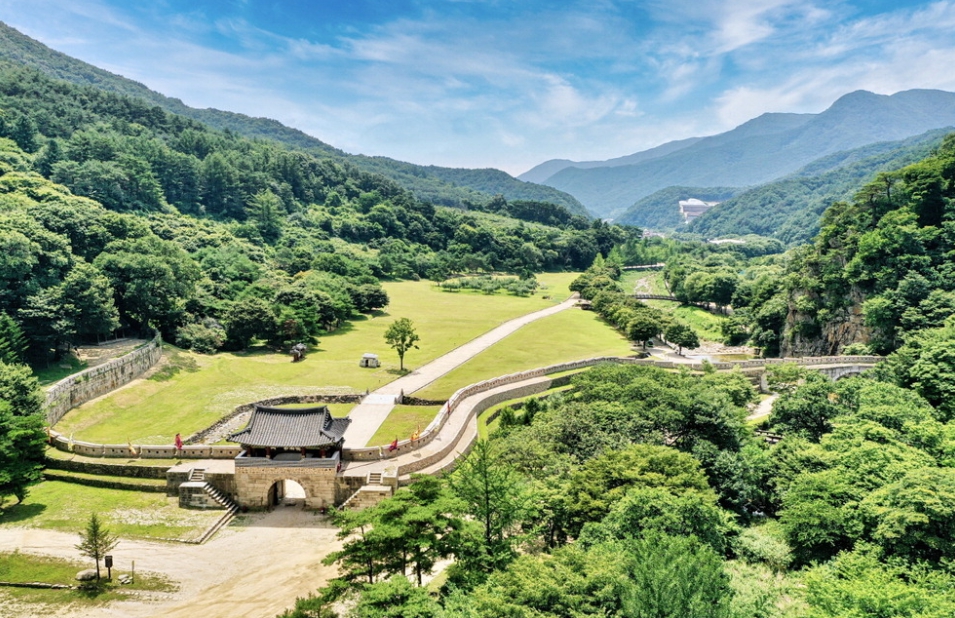
A Mungyeong day trip from Seoul is one of those rare Korea experiences that almost no foreign travelers know about — yet if you’ve watched Kingdom, The Red Sleeve, Hwarang, or basically any Joseon-era K-drama in the last twenty years, you’ve probably already seen Mungyeong without realizing it. This small mountain city in North Gyeongsang Province is home to Korea’s largest historical drama filming set, plus an ancient mountain pass that defended the country during the Imjin War, and a converted coal-mine tunnel that’s now a glowing tea-and-wine experience. It’s two hours from Seoul, easy to reach without Korean, and absolutely worth a day of your trip.
Quick Answer
Take the bus from Dong Seoul Bus Terminal (Gangbyeon Station, Line 2) to Jeomchon Bus Terminal — about 2 hours, $12–19 one-way. From there, a local bus or short taxi gets you to Mungyeongsaejae. Hit the open set first (K-drama central), walk the historic gates of the provincial park, then end at the Omija Tunnel before catching the bus back. You can absolutely do it all in one day.
Why Mungyeong Should Be on Your Korea Itinerary
Most international travelers in Korea stick to the standard loop — Seoul, Busan, Jeju, maybe Gyeongju. Mungyeong rarely makes the list, which is exactly why it’s worth visiting:
- Almost no English-speaking tourists. You’ll have most attractions to yourself, share trails with Korean families and weekend hikers, and get a much more local feel than you’d get at the major destinations.
- The largest sageuk filming set in Korea. If you watch Korean historical dramas, this is essentially Hollywood for the genre.
- Real history, not just replicas. The mountain passes here defended Joseon Korea during the Imjin War in the 1590s, and the original three fortress gates are still standing.
- It’s a true day trip. No overnight required, no complicated logistics. You’re back in Seoul for dinner.
The K-Dramas Filmed at Mungyeongsaejae
The Mungyeongsaejae Open Set was built in 2000 specifically for KBS to film historical dramas, and over the years it’s hosted more than 115 dramas and 40 films. If you’re a K-drama fan, the recognition factor walking through here is intense. Here are the ones most international viewers will know:
- Kingdom (2019, Netflix) — Probably the most internationally famous show filmed here. Many of the palace exterior scenes and rural village shots were captured at the Mungyeong set.
- The Red Sleeve (2021) — The Lee Junho and Lee Se-young romance that swept Korea. The royal court scenes used this set extensively.
- Hwarang (2016) — Kim Taehyung (V of BTS) made his acting debut here. Major BTS-fan pilgrimage destination.
- The Moon Embracing the Sun (2012) — The Kim Soo-hyun and Han Ga-in classic. Many of the Joseon palace scenes were shot in the open set’s recreated Gyeongbokgung structures.
- The Crowned Clown (2019) — Yeo Jin-goo’s dual-role drama.
- Bossam: Steal the Fate (2021) — Jung Il-woo and Kwon Yuri (Girls’ Generation).
- Bon Appétit, Your Majesty (2025) — The recent Im Yoon-ah (Girls’ Generation) time-travel fantasy drama.
- Taejo Wang Geon (2000) — The original blockbuster sageuk that the set was built for.
K-drama fan tip: The set has installed location maps and information leaflets with photos from major productions, especially after the recent surge in drama-tourism interest. Pick one up at the entrance — it’ll show you exactly where specific scenes were filmed.
Getting from Seoul to Mungyeong
There’s no direct train and no KTX station in Mungyeong — the train option requires multiple transfers and takes over four hours, so skip it. Take the bus.
Bus from Dong Seoul Bus Terminal (Recommended)
This is the fastest and most frequent option:
- From: Dong Seoul Bus Terminal (동서울터미널) — directly connected to Gangbyeon Station, Subway Line 2.
- To: Jeomchon Bus Terminal (점촌터미널). Note: “Jeomchon” is the main town of Mungyeong city — buses to “Mungyeong” actually arrive at Jeomchon, not at Mungyeongsaejae.
- Frequency: Every 20–30 minutes throughout the day.
- Travel time: About 2 hours 10 minutes.
- Cost: ₩15,000–25,000 ($12–19) one-way.
- How to book: Buy tickets at the terminal counter or use the Bus Tago app (English available) for advance booking. On weekdays you can usually just show up.
Alternative: Seoul Express Bus Terminal
If you’re staying near Gangnam, the Seoul Express Bus Terminal (Line 3 / 7 / 9) also runs buses to Jeomchon, but only every two hours. Same price, same travel time. Use Dong Seoul if you can — the frequency is better.
From Jeomchon to Mungyeongsaejae
Jeomchon Bus Terminal is the main hub, but Mungyeongsaejae Provincial Park is about 15 km away in Mungyeong-eup. Two options:
- Local bus from Jeomchon Bus Terminal — runs every 20–40 minutes during the day, fare ₩1,500–2,500. Pay with cash or T-money card. Last bus around 8:00 PM.
- Taxi — about ₩15,000–20,000 ($11–15) and 15 minutes. Use the Kakao T app to call one without a language barrier. This is what most foreign visitors end up doing, and honestly it’s worth the convenience.
Heads up about the return trip: The last express bus from Jeomchon back to Seoul typically departs around 8:30–9:00 PM, but local buses to Jeomchon from Mungyeong-eup stop running by 8:00 PM. Plan to be back at Jeomchon Bus Terminal no later than 7:30 PM if you’re using public transit both ways.
The Three Must-See Spots
1. Mungyeongsaejae Open Set — The K-Drama Filming Site
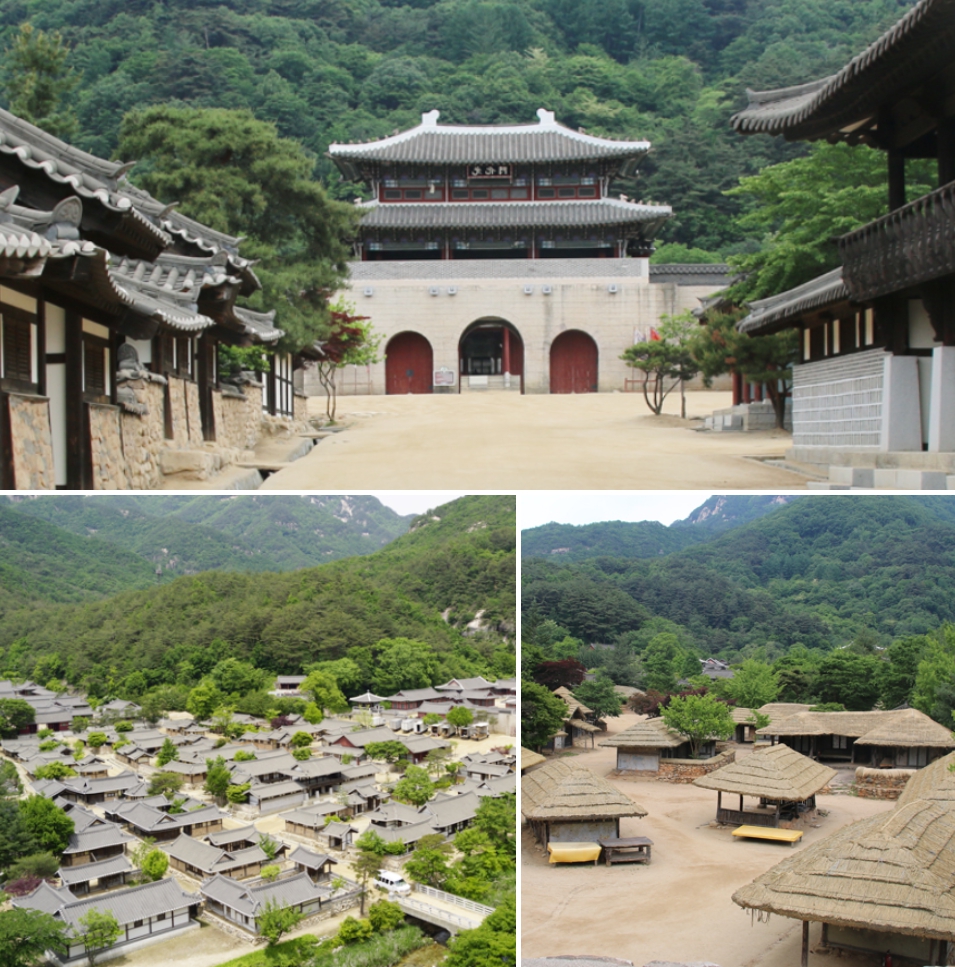
This is the main reason most foreign travelers come to Mungyeong. Built in 2000 with a 3.2 billion won investment, the set spans 65,755 square meters and includes 2 palace structures, 42 tile-roof noble houses, 40 thatched-roof commoner houses, and 13 other buildings. The most famous spot is the full-scale recreation of Gwanghwamun Gate, the iconic entrance to Gyeongbokgung Palace.
Walking the set, you’ll move through what feels like an entire Joseon-era city — a noble district, a commoners’ market street, palace courtyards, and government offices. The mountain backdrop adds a cinematic quality that’s hard to replicate at the actual palaces in Seoul.
Practical info:
- Entry fee: ₩2,000 adults (about $1.50). Often free during the Mungyeong Tea Bowl Festival (early May).
- Open: Year-round, but closed January 1, Lunar New Year, Chuseok, and during active filming or maintenance periods.
- Hanbok rental: Available on weekends and public holidays. Highly recommended for photos.
- Time needed: 1.5–2 hours minimum, longer if you’re stopping for photos at every drama location.
2. Mungyeongsaejae Provincial Park — The Historic Mountain Pass
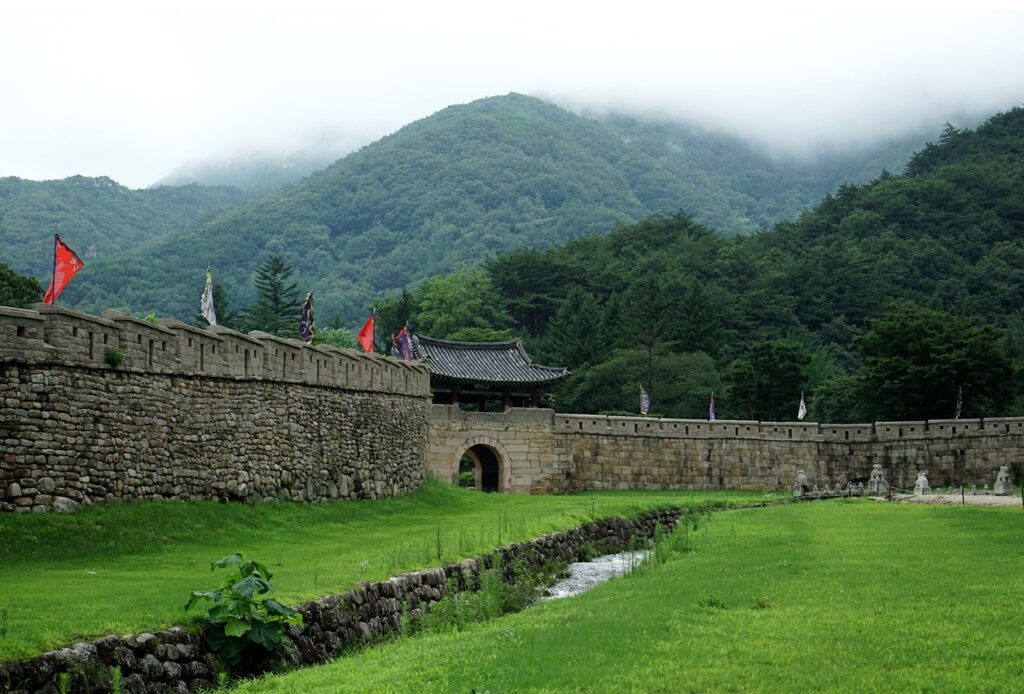
The open set sits inside the larger Mungyeongsaejae Provincial Park, which preserves an ancient 5.5-square-kilometer section of the Yeongnam-daero — the historic main road connecting the Han River basin (around Seoul) to the Nakdong River region (Busan). For centuries this was the primary overland route across central Korea.
Three fortress gates — Juheulgwan (1st gate), Jogokgwan (2nd gate), and Joryeonggwan (3rd gate) — were built during and after the Imjin War (1592–1598) to defend the pass against Japanese invasion. They’re still standing, and walking between them on the original unpaved path is one of the more atmospheric historical experiences you can have in Korea.
Practical info:
- Entry fee: Free (24 hours). Parking is paid.
- Distance between gates: About 6.5 km from Gate 1 to Gate 3 (one way). Most visitors walk to Gate 1 and back.
- Electric shuttle car: If you don’t want to walk the whole thing, an electric tram runs from the museum entrance to the open set (Course A, ₩2,000 adults) and out to the second gate (Course C, ₩5,000 adults). Slow enough to enjoy the scenery.
- Best for: History buffs, hikers, and anyone who appreciates atmospheric old roads.
3. Mungyeong Omija Theme Tunnel
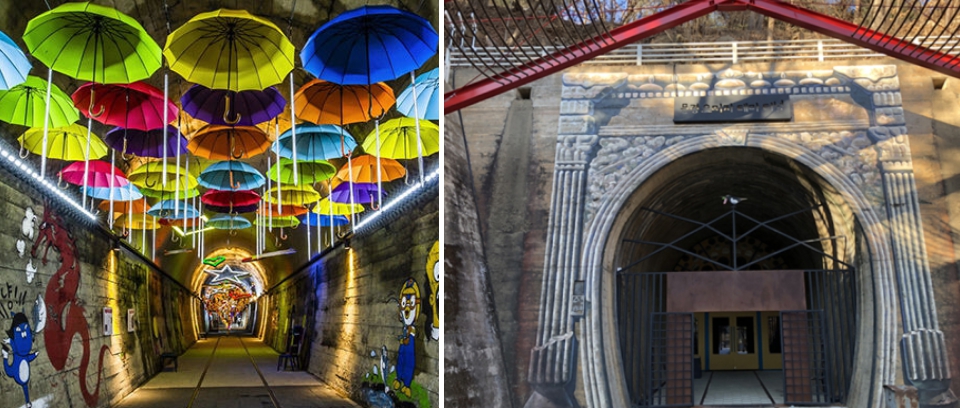
This one’s the surprise of the trip. The Omija Tunnel is a 540-meter-long converted coal-mining tunnel (originally Seokhyeon Tunnel) that’s been turned into a year-round LED-lit walking attraction with an indoor temperature kept at 14–17°C — cool in summer, warm in winter.
Inside, you’ll find star-light installations, wall murals, trick-art photo spots, and a tasting room serving omija (Schisandra berry) wine and beverages. Mungyeong is Korea’s main omija-producing region, so this is the place to actually try it. The berry is famous for having all five tastes — sweet, sour, bitter, salty, pungent — and the local wine is unique enough to be worth the ₩3,500 entry fee on its own.
Practical info:
- Entry fee: ₩3,500 adults.
- Time needed: 45 minutes to an hour, longer if you sit down for an omija tasting.
- Bonus: The tunnel is right next to Jinnam Bridge, one of the official “Mungyeong 8 Scenic Views,” with river and old-fortress mountain scenery just outside the exit.
- Best for: Families, hot summer days, anyone who wants to bring home something different.
A Realistic One-Day Itinerary
Here’s how to fit all three into a single day from Seoul:
- 7:30 AM Subway to Gangbyeon Station, walk to Dong Seoul Bus Terminal
- 8:00 AM Bus departs for Jeomchon
- 10:15 AM Arrive at Jeomchon, taxi to Mungyeongsaejae (15 min)
- 10:45 AM Walk through provincial park to Gate 1, then continue to the open set
- 11:30 AM Explore the K-drama open set (1.5–2 hours)
- 1:30 PM Lunch near the park entrance — try local Mungyeong specialties like yakdol-gui (stone-grilled pork)
- 3:00 PM Taxi to the Omija Theme Tunnel
- 4:30 PM Tunnel done, taxi back to Jeomchon Bus Terminal
- 5:30 PM Bus back to Seoul
- 7:45 PM Back at Dong Seoul, in time for dinner in the city
If you skip the Omija Tunnel, you can take it slower at the open set and provincial park and still make it back by early evening. If you’d rather stay overnight, there are mid-range hotels (the Best Hotel near the park entrance is popular) and a resort right at the Saejae park gates.
When to Visit Mungyeong
- Spring (April–May): Best season. Mild weather, cherry blossoms early in April, and the Mungyeong Tea Bowl Festival (early May) often makes the open set free to enter.
- Summer (June–August): Hot but the Omija Tunnel becomes a perfect cool-down stop. Best avoided on weekends due to local crowds.
- Autumn (October–November): Stunning foliage along the Saejae mountain trail. Arguably the most photogenic time of year.
- Winter (December–February): Quiet and atmospheric. Snow on the old fortress gates is gorgeous, but bring proper layers — Mungyeong gets noticeably colder than Seoul.
Practical Tips for Foreign Travelers
- Bring cash. Mungyeong is more rural than Seoul. Cards work at major attractions and chain restaurants, but smaller vendors, taxi drivers, and the local bus prefer cash. ₩50,000 in small bills covers a day comfortably.
- Download Naver Map or Kakao Map before you go. Google Maps barely works for transit and walking directions in rural Korea. Both Korean apps have English versions.
- Save the Korean address. Drivers and locals will recognize “Mungyeongsaejae Provincial Park” if you show them 문경새재 도립공원 in Korean — keep it in a screenshot or note on your phone.
- Wear comfortable walking shoes. The provincial park trails are gentle but unpaved. Sandals or formal shoes will not be comfortable.
- English signage is limited. Major attraction names are bilingual, but smaller restaurants and shops are Korean-only. Papago translation app handles menus and quick conversations well.
- Festival season check. Visiting during the Mungyeong Tea Bowl Festival (early May) means free open-set entry, more food vendors, and traditional ceramics demos — but also more crowds. Check the Mungyeong city tourism site for exact dates each year.
The Bottom Line
A Mungyeong day trip from Seoul is the easiest way to step into a Joseon-era K-drama in real life — and to see a side of Korea most international travelers never reach. Take an early bus, prioritize the open set if you only have time for one stop, and you’ll be back in Seoul by dinner with stories that almost no one else on your trip will have.