
Korea has plenty of scenic train rides. So does Japan. So does Switzerland. What makes the Korea Sea Train (서해금빛열차, also called the West Gold Train) genuinely unique isn’t the scenery — it’s the traditional Korean ondol heated-floor compartments where you take off your shoes, sit cross-legged on a warm floor, and watch the West Sea coast roll past for three hours. There’s no other passenger train in the world quite like it.
Pair that with the destination — Korea’s UNESCO World Heritage-listed Getbol tidal flats, recognized in 2023 as one of the most ecologically important coastal areas in East Asia — and you have a day trip that’s essentially impossible to replicate anywhere else. Two distinctly Korean experiences, one ride, one day.
This isn’t a trip I’d recommend to a first-time visitor with only 4–5 days in Korea. Three hours each way to a small port town isn’t the most efficient use of a short trip. But if you’re staying a week or more, or if you’ve already done the standard Seoul–Busan circuit and want something deeper, this is one of the more memorable days you can plan in Korea. Here’s what to know.
QUICK FACTS
Train name: Korea Sea Train / West Gold Train (서해금빛열차, train #2551/2552)
Route: Yongsan (Seoul) ↔ Janghang ↔ Iksan, along the West Sea coast
Duration: About 3 hours one-way (Yongsan to Janghang)
Direction: Runs both ways — you can also start from Iksan if you’re already in southern Korea
Locomotive: Diesel-hauled (the Janghang Line isn’t fully electrified yet)
Schedule: Thursday through Monday (Tuesday and Wednesday off)
Standard fare: ₩30,000–35,000 ($22–26 USD) one-way standard seat
Ondol compartment: Additional fee on top of standard fare
Korail Pass: ❌ NOT covered — tourist train requires separate ticket
Booking opens: 31 days before departure
Best for: Travelers staying 7+ days who want a uniquely Korean experience
⚠️ IMPORTANT FOR KORAIL PASS HOLDERS
Some older blog posts and even some tour booking sites list the Sea Train as a “tourist train covered by Korail Pass.” This is incorrect. The Sea Train is classified by Korail as a special tourist train (특별관광열차) and requires a separate ticket purchase, even if you hold a valid Korail Pass. Always book the Sea Train as a standalone ticket through korail.com or major booking platforms.
What Makes the Ondol Compartments Special
If you’ve spent any time in Korea, you’ve encountered ondol — the traditional Korean underfloor heating system that’s been used in Korean homes for over a thousand years. It’s the reason Koreans sit and sleep on the floor: the floor itself is the heater. Modern Korean apartments still use ondol, but instead of wood fires beneath the floor, they circulate hot water through pipes.
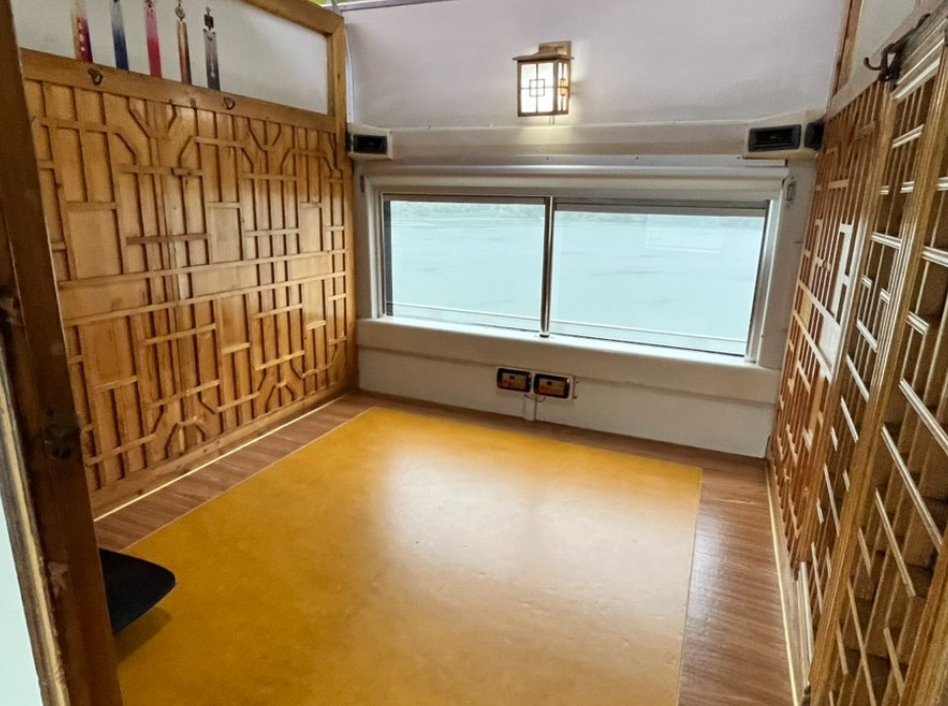
The Sea Train has 9 dedicated ondol compartments in Car 5 — small private rooms designed like a traditional Korean home interior. The corridor running through Car 5 has a stone-path floor design and jogakbo (Korean patchwork cloth) wall decoration, giving the whole car a hanok (traditional Korean house) atmosphere. You take off your shoes at the doorway, step onto the heated wooden floor, and sit. Each compartment includes:
— Adjustable floor heating (turn it up or down as you like)
— A small TV
— Low backrest seats you can lean against, or use the floor itself
— Individual power outlets for charging devices
— A sliding door for privacy
For Korean families, this feels familiar — it’s basically a small sarangbang (traditional Korean living room) moving along the coast. For international visitors, it’s genuinely a “you can only do this here” experience. I’ve taken scenic trains in Japan, Switzerland, and Norway, and none of them recreate the experience of sitting on a warm wooden floor while a country moves past your window.
The compartments hold a minimum of 3 and maximum of 6 people, with a flat additional fee of ₩40,000 ($30 USD) per compartment on top of the standard fare. Since the fee is per room (not per person), groups of 4–6 get the best value — about ₩7,000–10,000 per person on top of the regular ticket.
They sell out almost immediately when booking opens 31 days in advance — typically within 5–10 minutes on weekends, sometimes faster during fall foliage season. If you want one, set a calendar reminder and book the moment booking opens at 7:00 AM Korea time.
If the Ondol Rooms Are Sold Out
Realistically, most international visitors trying to book a few days in advance won’t get an ondol compartment. The good news: the rest of the train is also designed as a tourist experience, not just transportation.
Car 3: The Healing Lounge (Café, Snack Bar, and Foot Spa)
Car 3 is the train’s combined lounge car, containing a casual café with window-facing tables, a snack bar selling light meals and drinks, and — most unusually — built-in foot bath stations using warm water. All three sections are open to every ticket holder regardless of seat assignment, so most passengers visit Car 3 at some point during the journey.
The café tables are arranged window-facing. Solo travelers can claim a window seat; groups get 4-person tables. The food selection is limited (light Korean meals, snacks, drinks, beer) but the atmosphere is the point — eating slowly while watching the coastline pass.
The foot spa stations are a small additional fee, bookable through the on-board staff. You sit on padded seating with your feet in a warm water basin while the train moves. Genuinely unusual — I can’t think of another passenger train in the world with built-in foot baths.
If you’re seated in a regular car, you can walk over to Car 3 for any of these, then return to your assigned seat.
Standard Seats
Standard reserved seats are spacious — wider than KTX seats, with more legroom — and large windows face the coast. The seats are actually repurposed Saemaeul-class seats (Korea’s premium intercity service), even though the train officially runs on a slower tourist classification. So while the train moves at moderate speed, you’re sitting in genuinely comfortable seats with deep recline angles. For the price (₩30,000–35,000 / $22–26 USD), these are honestly fine.
Pro tip: Sit on the right side going west (Seoul → Janghang) and the left side going east (returning) to be on the sea-facing side for most of the journey.
Onboard Layout: What Each Car Has
The Sea Train is a 5-car configuration, and walking through all of them is part of the experience. Most passengers wander between cars during the 3-hour trip rather than staying in one seat. Here’s what you’ll find:
CAR-BY-CAR BREAKDOWN
Cars 1 & 2: Standard reserved seating with Saemaeul-class seats
Car 3: Healing Café (lounge-style with window-facing tables and food service)
Car 4: Standard seating + bicycle rack (yes, you can bring a bike)
Car 5: The five ondol compartments — only accessible with a ondol ticket
A few things worth noting: the bicycle rack in Car 4 makes this a viable option if you’re doing a longer cycling trip down the west coast (Korea has a national bike trail along the river systems that connects to several west coast routes). Car 3’s Healing Café is open to all ticket holders, not just those seated in that car — most passengers visit at some point during the journey.
Scenic Highlights Along the Route
The three hours pass faster than you’d expect because the scenery genuinely keeps changing. The standout moments to watch for:
Geumgang River Estuary Barrier (between Gunsan and Janghang)
The single most striking view on the route. The train crosses the Geumgang Estuary Barrier (금강하구둑), a massive sea wall that separates the Geumgang River from the West Sea. Looking out one window you see the freshwater river; looking out the other, you see the saltwater sea and exposed tidal flats — divided by nothing more than a concrete barrier.
This crossing takes about 5 minutes and happens roughly 2 hours into the Yongsan-to-Janghang journey. Set a quiet alarm or just keep watch — both sides of the train have great views, but the sea side is the more photographed one.
Just before the barrier crossing, the train passes through Gunsan Station (군산역) — originally built in 1912 during the Japanese colonial period to ship grain and goods out of the West Coast ports. If you have any interest in Korean colonial history, the original Gunsan was a major shipping hub, and the city retains preserved Japanese-era architecture in its old downtown (worth a separate visit if you’re staying overnight in the region).
Mudflats and Rice Paddies
For long stretches, particularly after Gunsan, the route runs through low-lying agricultural areas and tidal coastal terrain. Rice paddies on one side, mudflats and salt evaporation ponds on the other. In late spring and early summer, the rice paddies are flooded mirrors that reflect the sky.
Old Rural Stations Between Daecheon and Hongseong
A portion of the Janghang Line still uses original single-track rural rail, with old wooden-floor stations the train passes through without stopping. The architecture is mid-20th century Korean rural — buildings most international visitors will never otherwise see. Korea is gradually upgrading this section to double-track electrified rail, with KTX-Eum trains expected to use the route within the next few years. If you want to see this older Korea, the next 2–3 years are the window before it changes.
Two Directions: Seoul-to-Coast or Coast-to-Seoul
Most foreign visitors think of this as a Seoul day trip — Yongsan to Janghang and back. But the Sea Train runs in both directions, which opens a different option if you’re already in southern Korea.
Option A — From Seoul (most common): Train #2551 leaves Yongsan around 8:28 AM. Spend the afternoon at Janghang’s pine forest and UNESCO mudflats. Return on a regular Saemaeul-ho train in the evening (the Sea Train return at this time may not run).
Option B — From Iksan or southern Korea: Train #2552 leaves Iksan around 3:57 PM and reaches Yongsan around 7:30–8:00 PM. This works if you’re already in southern Korea (Jeonju, Gwangju, Busan after a transfer) and want to make the Sea Train your transit back to Seoul. You’ll see the West Sea sunset from the train — arguably the better view, since the sun sets directly over the water you’re traveling alongside.
If you’re doing a multi-city Korea trip (Seoul → Jeonju → Iksan → back to Seoul), Option B turns the journey home into the highlight rather than just an end-of-day grind.
UNESCO Getbol: Why the Destination Matters
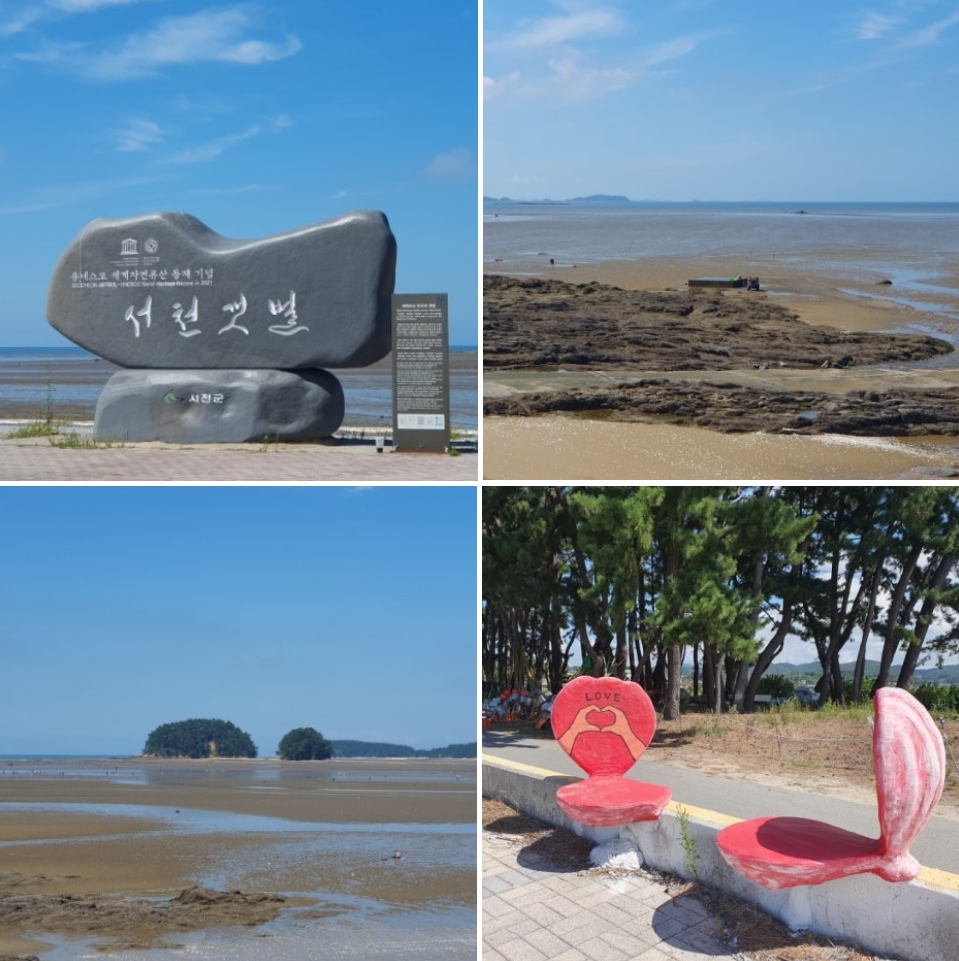
The Sea Train terminates at small towns most international tourists have never heard of — Janghang, Iksan, Gunsan. The reason to go isn’t the towns themselves. It’s what’s on the coast just outside Janghang Station: the Seocheon Getbol, part of UNESCO’s “Getbol, Korean Tidal Flats” World Heritage inscription from 2023.
Getbol (갯벌) is the Korean word for tidal flats — vast coastal mudflats exposed at low tide and submerged at high tide. The Korean Yellow Sea coast has some of the most ecologically rich tidal flats in the world, particularly important as a stopover for migratory birds on the East Asian-Australasian Flyway. The black-faced spoonbill, one of the most endangered birds in Asia, depends on these specific mudflats during its annual migration.
UNESCO recognized four Korean tidal flat sites in 2021 (Suncheon, Yubu, Gochang, Boseong-Sunchon) and added a fifth — the Seocheon Getbol near Janghang — in 2023. This is the one accessible by Sea Train.
What You’ll Actually See
At high tide: The mudflats are completely underwater. You see ocean stretching to the horizon, with the boardwalk through the pine forest sitting just above the waterline.
At low tide: The water retreats hundreds of meters, revealing intricately patterned mud, small crabs scuttling across the surface, shorebirds picking at exposed organisms, and the deep slow ecology of the tidal zone. This is when the area is most striking. Most local guides recommend timing your visit for the low-tide window.
Tide timing matters. Tides on the Korean west coast typically have a 4–6 hour rhythm — high tide twice a day, low tide twice a day, but the exact times shift by about 50 minutes each day. Before you book your Sea Train, check the tide chart for Janghang at the Korea Hydrographic and Oceanographic Agency website (khoa.go.kr — has English interface) and pick a date where low tide falls between roughly 1:00–4:00 PM (after your train arrives).
Barefoot Mudflat Walking
There’s a designated mudflat entry point near the pine forest, with foot-washing stations and shoe storage. You step onto the mudflat barefoot, walk out across the soft warm mud, and experience what Koreans call get-bol gulbu-jjim (갯벌 굴부찜) — the local term for the therapeutic warm-mud foot experience.
The mud is naturally warm in summer (mid-20°C / 75°F+) from sun exposure. It feels somewhere between a spa treatment and standing in soft pudding. Small crabs scatter as you walk; you can pick up shells, see barnacles on wooden pilings, and look back at the pine forest from the seaward side. Most visitors spend 30–60 minutes out on the flats before returning to wash off.
This is genuinely a once-in-a-lifetime activity for most international visitors. UNESCO Heritage sites you can casually walk into, barefoot, are not common.
Janghang Pine Forest: The Pairing
Adjacent to the UNESCO mudflats — and connected by a coastal boardwalk — is the Janghang Songnim Forest Park, a 70-year-old coastal pine forest planted in 1954 as a windbreak against sand and sea winds.
The original plantation was done by local high school students. The trees were 2 years old when planted; they’re now over 70 years tall and form a 1.5 km dense coastal forest with paths weaving through. Beneath the pines, the park has cultivated one of Korea’s largest plantings of maekmundong (purple lily turf) — a low-growing ground cover that blooms in dense purple carpets from late August through mid-September.
If you’re visiting during the late August through mid-September window, you’ll see one of Korea’s most photographed seasonal sights: pines towering above an unbroken purple floor. Local festival timing usually falls in early September.
The 15-Meter Skywalk
Built within the pine forest is the Janghang Skywalk — a 15-meter-high, 236-meter-long walkway through the upper canopy, with mesh flooring that lets you look straight down through the trees. Admission is ₩4,000 ($3 USD), of which ₩2,000 is returned as a Seocheon County voucher usable at local restaurants. No elevator — stairs only.
What to wear: Flat closed shoes only (heels and sandals can catch in the mesh). The view from the top reaches over the tidal flats during low tide.
Boardwalk Over the Mudflats
Near the campground at one end of the pine forest, a wooden boardwalk extends out over the tidal flats. At high tide, you’re walking over water; at low tide, you can see the mudflat ecosystem directly beneath you. The end of the boardwalk has a shaded rest area with benches — popular for sunset viewing, since the sun sets directly into the West Sea here.
Other Destinations: Gunsan and Iksan
Janghang is the closest stop to the UNESCO Getbol mudflats, but the Sea Train also stops at Gunsan (just before Janghang) and continues to Iksan (the terminus). Both offer entirely different experiences worth considering depending on your interests.
Gunsan — Korean Colonial History
Gunsan is one of Korea’s best-preserved Japanese colonial-era cities. The “Modern History District” (근대화거리) is a walkable area with preserved 1900s–1940s buildings from when Gunsan was a Japanese rice export port — including warehouses, banks, and the famous Hirotsu House, a Japanese-style residence that’s been used as a Korean film location.
Other Gunsan highlights:
— Gyeongam-dong Railway Village (경암동 철길마을): A neighborhood built along disused train tracks, popular for Instagram photography
— Choneun Photo Studio (초원사진관): The filming location for the 1998 Korean film “Christmas in August,” now a small museum
— Eunpa Lake Park (은파호수공원): Lakeside walking park, good for sunset
— Iseongdang Bakery (이성당): Korea’s oldest bakery, famous for its red bean bread. Long lines but worth it.
Best for: Travelers interested in modern Korean history, photography, or fans of Korean cinema. Gunsan Station is one stop before Janghang, about 2.5 hours from Yongsan.
Iksan — Ancient Baekje UNESCO Site
Iksan, the Sea Train’s terminus, is a more unusual UNESCO pairing for the trip: the city is home to the Mireuksa Temple Site (미륵사지), part of the Baekje Historic Areas inscribed as UNESCO World Heritage in 2015. This means a Sea Train day trip to Iksan can hit two UNESCO sites in one day — the natural Getbol tidal flats and an ancient Baekje archaeological site.
Mireuksa was one of the largest Buddhist temples in 7th-century Baekje. The original temple is gone, but the site preserves the massive Mireuksa Stone Pagoda — the oldest and largest stone pagoda in Korea, recently restored after a 20-year restoration project. The on-site museum displays excavated artifacts.
Best for: History travelers, anyone interested in pre-modern Korea, those who want to combine natural and cultural UNESCO sites. Iksan is the train terminus, about 3 hours from Yongsan.
Bonus: Iksan is about 30–40 minutes from Jeonju by car or local bus — home to Korea’s most famous traditional hanok village. If you have flexibility, the Sea Train + Iksan + overnight Jeonju makes for an excellent 2-day cultural route.
How to Book the Sea Train
Since the Korail Pass does NOT cover this train, you’ll need to buy a standalone ticket. Three options:
Option 1: Korail Official Site (Cheapest)
Book directly at korail.com — Korail’s official English-language site for foreign tourists. Standard fare runs ₩30,000–35,000 ($22–26 USD) one-way Yongsan to Janghang. Ondol compartment supplements vary. Booking opens 31 days before departure.
Watch out: Some foreign credit cards fail on Korail’s payment gateway. If your card doesn’t work, the next two options are backups.
Option 2: Klook, Trazy, or Pelago
Third-party booking platforms with English support and reliable foreign card acceptance. Prices are typically the same or slightly higher than Korail direct, but the interface is friendlier and customer service handles foreign payment issues. Useful as a backup if Korail’s site doesn’t work for you.
Option 3: KORAIL Travel Center at Major Stations
Walk into the Travel Center at Seoul Station, Yongsan Station, or Incheon Airport. Show your passport, request a Sea Train ticket for your chosen date. English-speaking staff usually available. Useful for last-minute booking, less useful for popular dates that have sold out online.
2026 Schedule (Verify Before Booking)
TYPICAL 2026 SCHEDULE
Train #2551 (Yongsan → Iksan)
Yongsan departure: ~8:28 AM
Janghang arrival: ~11:29 AM
Iksan arrival: ~12:00 PM
Train #2552 (Iksan → Yongsan)
Iksan departure: ~3:57 PM
Janghang departure: ~4:30 PM
Yongsan arrival: ~7:30–8:00 PM
Operating days: Thursday through Monday
Off days: Tuesday and Wednesday
Schedules can change seasonally. Always verify on the day at korail.com or the KorailTalk app.
Note on the return: If you take the Sea Train out in the morning, the Sea Train return doesn’t typically run late evening. Many day-trippers take the Sea Train outbound to enjoy the experience, then return on a regular Saemaeul-ho or Mugunghwa-ho train (which run later and don’t require special booking).
From Janghang Station to the Pine Forest
Bus #600 runs from Janghang Station to the Songnim Pine Forest area. Pay ₩1,500 ($1 USD) with a T-money card. The stop you want is Songnim 2-ri (송림2리), about 20 minutes from the station.
From the Songnim 2-ri bus stop, walk uphill and turn left to reach the pine forest entrance. The forest is free to enter; the Skywalk costs ₩4,000 ($3 USD).
If you miss the bus: Taxis at Janghang Station are usually under ₩10,000 ($7 USD) to the pine forest area. Save the return taxi’s number to call when you’re ready to head back.
Sample Day Plan
FULL DAY ITINERARY (BEST FOR LATE AUGUST – SEPTEMBER)
7:30 AM — Arrive at Yongsan Station, breakfast at one of the station cafes
8:28 AM — Sea Train departs Yongsan (board on the right side for sea views)
11:29 AM — Arrive Janghang Station
12:10 PM — Bus #600 to Songnim 2-ri (or taxi)
12:35 PM — Walk to pine forest, enter the park
1:00 PM — Janghang Skywalk (45 min)
2:00 PM — Walk through the pine forest, see the maekmundong beds
3:00 PM — Boardwalk over the UNESCO mudflats (low tide ideally)
4:00 PM — Barefoot mudflat walking, wash feet, rest
5:30 PM — Early dinner at a local seafood restaurant (use the Skywalk voucher)
6:30 PM — Bus #600 back to Janghang Station
7:37 PM — Saemaeul-ho return train to Yongsan (standard ticket, no Sea Train at this hour)
10:48 PM — Arrive Yongsan, end of day
Total day length: ~15 hours. Long but doable.
When to Go
Late August to mid-September (best overall): The maekmundong purple bloom is at peak. The pine forest floor becomes an unbroken purple carpet. This is the most photographed and most photographed-worthy time of year. Warm enough for comfortable barefoot mudflat walking.
October (second best): Cleanest air, best sunset conditions, comfortable temperatures. No purple bloom, but the pine forest itself is at its most photogenic in autumn light.
May–June (good): Mild weather, clear skies, lower crowds. Tides are gentle. Mudflats are pleasant but not warm enough for extended barefoot walking.
Winter (avoid): The coastal walks are exposed and very cold. Mudflat walking essentially closed. The ondol-heated train ride is still nice, but the destination doesn’t shine.
Tips for International Visitors
Bring layers. The train is comfortable, but the coastal area can be windy regardless of season. A light jacket helps even in summer.
Extra socks. After the mudflat walk, even after washing your feet, you’ll want clean dry socks for the return train.
Cash for the bus. Bus #600 prefers T-money but accepts cash. Bring small bills — drivers don’t always have change.
Janghang Station has minimal English signage. Use Naver Map or KakaoMap to navigate. Both work better than Google Maps for Korean rural transit.
The Skywalk voucher is real money. The ₩2,000 you get back is a Seocheon County voucher accepted at most local restaurants and shops. Use it for dinner — don’t let it expire unused.
Bring food. The Healing Café on board has limited options. Many Korean families bring their own snacks, kimbap, or drinks. This is completely acceptable.
Frequently Asked Questions
Is the Sea Train really worth a full day from Seoul?
Honest answer: it depends on your overall Korea time. If you have 4–5 days, probably not — that day is better spent in Seoul or a closer destination. If you have 7+ days, especially if you’ve already done the main Seoul attractions and a Busan or Jeju leg, this is one of the more memorable single days you can plan.
Why doesn’t the Korail Pass cover this train?
The Sea Train is classified by Korail as a special tourist train (특별관광열차), which is a separate category from the regular trains the Korail Pass covers (KTX, ITX, Mugunghwa, etc.). The Korail Pass explicitly excludes special tourist trains. Some other tourist trains follow similar rules.
Are the ondol compartments comfortable if I’m tall or have knee problems?
Sitting cross-legged on the floor for three hours can be hard if you’re tall or have knee issues. The compartments have low backrest seats you can lean against, and you can stretch your legs out. If three hours on the floor sounds painful, standard seats might be more comfortable.
The fare seems high for a tourist train moving at moderate speed. Why?
The Sea Train is classified by Korail as a “temporary tourist train” (임시열차), which sits below Mugunghwa-ho and Saemaeul-ho in operational priority, but the fare is set at Saemaeul-ho level. The reason is the experience itself: the train uses repurposed Saemaeul-class seats, includes the Healing Café, foot spa, and ondol rooms, and the train slows down at scenic points along the route. You’re paying for a tourist train experience, not for fast transportation. If you only need to get from Seoul to Janghang or Iksan quickly, regular Saemaeul-ho or Mugunghwa-ho trains at slightly lower fares work fine and are covered by Korail Pass.
Can I bring my bicycle on the Sea Train?
Yes — Car 4 has a dedicated bicycle rack. If you’re planning a cycling trip down Korea’s West Coast (the national bike trail network connects to several routes in this region), the Sea Train is one of the easier ways to ride your own bike from Seoul down to the coast.
Can I see the UNESCO mudflats without going on the Sea Train?
Yes. The Seocheon Getbol is reachable by regular Saemaeul-ho or Mugunghwa-ho train to Janghang Station (covered by Korail Pass), plus the same Bus #600 from there. The Sea Train is about the train experience, not the only access to the destination. If your main interest is UNESCO Heritage, take any train to Janghang.
Is the barefoot mudflat walking safe?
Yes. The designated entry points have foot-washing stations, shoe storage, and well-marked walking areas. Stay on the marked area, don’t venture out at very low tide far from shore (incoming tides can come in fast), and use the wash stations afterward. The mud is naturally warm and clean.
Are there other UNESCO Getbol sites worth visiting?
Yes — five total Korean Getbol sites are UNESCO listed (Suncheon, Yubu, Gochang, Boseong-Sunchon, Seocheon). The Seocheon site (near Janghang) is the most accessible from Seoul by train. Suncheon has perhaps the most developed visitor infrastructure but requires a longer journey.
Should I get off at Janghang, Gunsan, or Iksan?
It depends on your interests. Janghang is for nature lovers (UNESCO Getbol tidal flats, pine forest, sunset over the sea). Gunsan is for history and photography fans (Japanese colonial architecture, film locations, the famous Iseongdang bakery). Iksan is for cultural travelers (UNESCO Mireuksa Baekje temple site, and easy connection to Jeonju). All three are valid Sea Train destinations and you can pick based on what you most want to see. If you’re torn, Janghang is the most “unusual” destination since the UNESCO mudflats aren’t on standard tour itineraries.
Can children enjoy this trip?
Yes — the ondol compartments are particularly good for families with young kids (room to move around), and the mudflat walking is a memorable kid-friendly activity. The Healing Café also has kid-friendly seating. Children under 6 ride free if seated on a parent’s lap.
The Korea Sea Train + Janghang day trip is a niche experience that won’t show up on most Korea itineraries — and that’s part of why it’s worth doing for the right traveler. The ondol-heated compartments are unique enough to justify the train ride on their own. Pair that with a UNESCO World Heritage tidal flat and a 70-year-old pine forest, and you have a day that feels distinctly Korean in a way the standard Seoul–Busan circuit doesn’t.
My honest recommendation: skip this if your Korea trip is under a week. Save it for travelers who’ve already seen the famous spots and want depth instead of breadth. Book those ondol compartments exactly 31 days out, plan around low tide, and bring extra socks.
Schedules, fares, and Korail Pass exclusions verified for April 2026. The Sea Train operates as a special tourist train (특별관광열차) and requires a standalone ticket — Korail Pass holders should buy this train separately. Always confirm current schedules at korail.com or the KorailTalk app before booking.