
Incheon International Airport is genuinely one of the world’s best-run airports — but on a busy holiday weekend, the wait at check-in and security can still eat 2 to 3 hours of your day. The difference between a relaxed departure and a stressful one usually comes down to four things: knowing about Smart Pass, doing online check-in correctly, choosing the right transport from Seoul, and understanding which rest options exist if you’re stuck with a long wait.
This guide covers the practical time-savers that locals use, including a few that most tourist guides miss — like the new Spa at Home facility that opened in Terminal 2 in 2025, or the expanded free nap zones near Asiana’s new T2 gates. If you follow even half of these tips, you can typically cut your airport time from the standard 3 hours to about 90 minutes for a domestic flight or 2 hours for an international one.
QUICK WINS — IF YOU ONLY DO 3 THINGS
1. Register for Smart Pass 3 days before your flight (saves 20–30 minutes at immigration)
2. Do online check-in 24 hours before departure and use Self Bag Drop (saves 30–60 minutes vs counter check-in)
3. Take AREX Express train from Seoul Station (43 minutes vs 60–90 minutes by bus or taxi)
Combined: about 90 minutes saved on a typical international departure.
1. Smart Pass — The Single Biggest Time Saver
The ICN Smart Pass system is Incheon’s facial recognition fast-track program, and as of 2026 it’s available to foreign passport holders, not just Koreans. Once registered, you walk through dedicated lanes at boarding gate access and security with face scan only — no need to repeatedly show your passport and boarding pass.
Time saved: Typically 20–30 minutes at peak times. Up to 60 minutes during major holidays (Lunar New Year, Chuseok, summer school break).
How to Register (Foreign Visitors)
Step 1: Download the “Smart Pass” app from the App Store or Google Play 3 to 5 days before your flight. Search by the official name.
Step 2: Open the app and follow the registration flow. You’ll need: your passport (with valid bio-data page), your boarding pass (digital format works), and a face photo taken in the app.
Step 3: Wait for verification — typically takes 5 to 30 minutes. You’ll get a confirmation in the app when ready.
Step 4: At the airport, look for the green “Smart Pass” lanes at security and boarding. Stand in front of the camera, wait for the green checkmark, walk through.
Important: Your Smart Pass registration is tied to a specific flight. For each new flight, you need to add the boarding pass to the existing app account — but the face data is saved for 5 years, so the second registration is much faster.
2. Online Check-In + Self Bag Drop
Most airlines open online check-in 24 to 48 hours before departure, depending on the carrier:
Korean Air, Asiana Airlines: Online check-in opens 48 hours before departure, closes 1 hour before. Both have well-designed apps with English support.
Low-cost carriers (Jeju Air, T’way, Jin Air, Air Premia, Air Busan): Online check-in typically opens 24 hours before departure. Closes 1 hour before for international flights.
Foreign airlines: Varies — check your airline’s app or website. Most major carriers operating from Incheon offer online check-in.
Why Self Bag Drop Matters
Once you’ve checked in online, you can skip the counter line entirely and use Self Bag Drop kiosks. The process:
1. Find a Self Bag Drop kiosk in your airline’s check-in area (usually marked clearly with the airline logo).
2. Scan your passport and boarding pass QR code.
3. Print and attach baggage tags as the kiosk instructs (it’ll guide you visually).
4. Place your bag on the conveyor belt for it to be scanned and accepted.
5. Done. Total time: usually 2 to 5 minutes vs 15 to 45 minutes at the counter on busy days.
After dropping your bag at Self Bag Drop, wait near the area for at least 5 minutes. If a prohibited item is detected during X-ray screening, the airline will call your phone before security. Missing the call means delays — worst case, your bag gets held and you fly without it.
3. Get to the Airport Faster
Transport choice can swing your total trip time by an hour or more. Three options ranked for speed:
AREX Express Train (Fastest, Most Predictable)
43 minutes from Seoul Station to T1, 51 minutes to T2. ₩11,000 ($8 USD). Reserved seating, dedicated luggage racks, no traffic risk. Runs every 25 to 40 minutes from 5:20 AM to 10:42 PM.
Bonus: Seoul Station has a City Airport Terminal on basement level B2 where many airlines (Korean Air, Asiana, several international carriers) allow pre-flight luggage check-in and immigration up to 3 hours before departure. Extremely useful — you arrive at Incheon with just a carry-on and walk straight to the gate.
Airport Limousine Bus (Convenient, Slower)
60–90 minutes depending on traffic and pickup point. ₩17,000 ($13 USD). Drops you directly at the departure level — no stairs, no walking with luggage. Best for families with heavy bags or travelers staying in residential areas not near a train station.
Taxi or Private Transfer (Door-to-Door)
60–90 minutes, ₩70,000–110,000 ($52–82 USD). Useful for very early flights when AREX and buses don’t run, or for groups where the cost splits well.
4. Pre-Flight Preparation Checklist
Roaming or eSIM: Set this up before leaving Seoul, not at the airport. Last-minute roaming setup at airport counters can take 20+ minutes during peak hours. Use Airalo, Holafly, or your carrier’s international plan from your hotel Wi-Fi.
Prohibited items check: Liquids over 100ml, lighters in carry-on, scissors, and power banks over a certain capacity all cause delays at security. The most common slowdown is liquids — even partly-full bottles count toward the 100ml limit. Check the Korea Airports Corporation prohibited items list (available in English) before packing.
Real-time congestion: Search “Incheon Airport departure” on Naver Map or Kakao Map to see live wait times at each terminal. The Incheon Airport official app also shows live security and immigration wait times. If T1 has 30-minute waits and T2 has 10-minute waits and your bag isn’t checked yet, this can affect your timing strategy.
Confirm your terminal: Always check 24 hours before departure. Asiana Airlines moved to Terminal 2 on January 14, 2026. If your booking is older or your travel agent is out of date, the wrong terminal could mean a 25-minute shuttle ride.
5. If You Have Extra Time — Resting at Incheon
If you arrive earlier than needed, or have a long layover, Incheon has surprisingly good rest options at every price point — including completely free options that most foreign travelers don’t realize exist.
Free Nap Zones — The Hidden Gem
If there’s one underrated facility at Incheon, it’s the Nap Zones. Completely free, available 24/7, and surprisingly comfortable — these aren’t the hard plastic benches you find at most airports. Each station is equipped with full reclining chairs that lean back almost flat, making it possible to actually sleep rather than just rest awkwardly upright. Most stations also have individual power outlets at each chair for charging your phone or laptop while you rest.
The atmosphere is genuinely sleep-friendly: dimmed lighting, low ambient noise, and most people around you are also napping. It feels closer to a quiet hostel dormitory than a typical airport seating area. When the zones aren’t crowded, you can essentially have your own row.
Important: All Nap Zones are after security and immigration, in the duty-free zone. They’re for passengers who have already cleared check-in and security — not for people still on the landside (arrival hall) of the airport. If you’re stuck before security with a long wait, the Spa on Air or Spa at Home facilities (covered below) are your option instead.
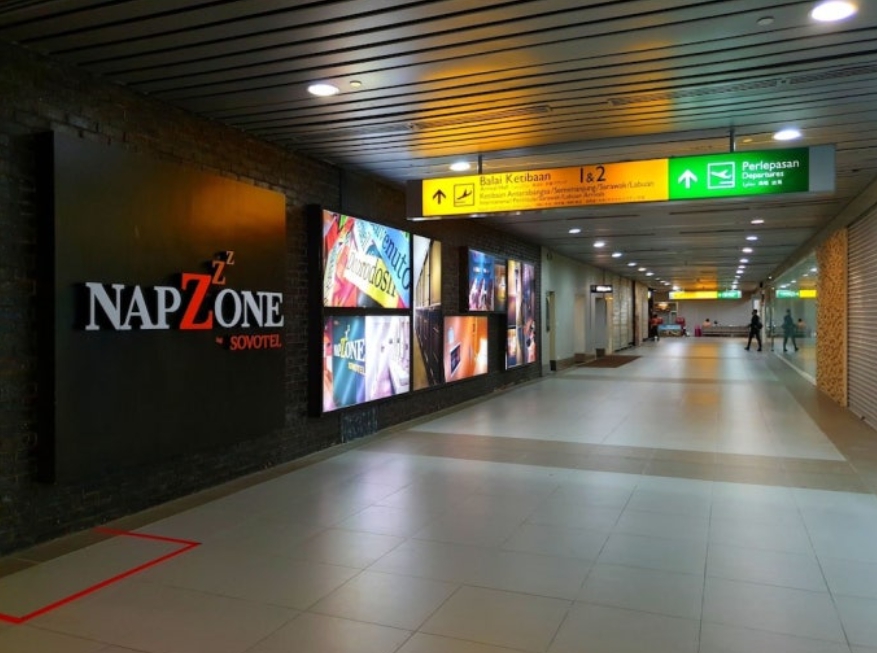
Nap Zone Locations
• Near Gate 25 — East Wing Transfer Lounge
• Near Gate 29 — West Wing Transfer Lounge
• Near Gate 41 — additional location
TERMINAL 2 (4F, Duty-Free Zone)
• Near Gate 231 — main area
• Near Gate 268 — expanded after Asiana’s January 2026 move to T2
Look for signs reading “Nap Zone” or “Rest Zone” once you’re in the duty-free area. From the main shopping concourse, you’ll typically take an escalator to the upper level and walk toward the indicated gate — the Nap Zones are tucked slightly off the main paths, which is part of why they stay quieter.
When to Use Them (And When to Avoid)
Best times: Late morning through afternoon (roughly 10:00 AM – 5:00 PM) usually have the most open seats. If you’re at the airport during this window, you’ll likely find a spot easily.
Crowded times: Evening through early morning (around 8:00 PM – 6:00 AM) — this is when most red-eye passengers and pre-dawn flyers use the zones. During these hours, all chairs are typically taken and you may need to walk between locations to find a free one.
Best use cases: 4–6 hour layovers (perfect duration for a real nap), early morning arrivals when your hotel can’t check you in until 3:00 PM, late-night flights where you arrive early to clear security and want to rest before boarding.
What to Bring
A jacket or light blanket: The duty-free zone is air-conditioned, often noticeably colder at night. Many travelers underestimate this — Incheon’s air conditioning runs on the strong side year-round. If you’re flying in from a tropical destination dressed for warm weather, you’ll feel it. The Nap Zones don’t provide blankets.
A neck pillow or eye mask: Optional but makes the difference between dozing and actual sleep. Many travelers buy a cheap neck pillow at one of the airport convenience stores if they didn’t pack one.
Phone alarm: The reclining chairs are comfortable enough that you will oversleep if you don’t set one. Set your alarm for 30–45 minutes before your boarding time, not your departure time. Multiple travelers have missed flights from too-deep Nap Zone naps.
Bag security awareness: Korea is unusually safe for sleeping in public, but treat valuables sensibly. The standard move is to loop a backpack strap around your leg or arm while sleeping. For larger bags, the spa facilities (which include luggage storage) are safer for deep sleep.
Bonus: Some Nap Zone areas are adjacent to children’s play areas, which means there are usually nearby restrooms, water fountains, and quiet seating for accompanying parents.
Spa on Air (T1) and Spa at Home (T2)
Korean-style jjimjilbang (bathhouse) facilities inside both terminals. Showers, hot tubs, sauna, sleeping rooms. Both are 24/7 and located outside the security zone, which means anyone can use them — including travelers who haven’t checked in yet, transit passengers, and people who’ve just arrived.
Spa on Air (Terminal 1, B1 East side): The original facility, jjimjilbang-style. Shower-only entry from ₩10,000 ($7 USD) for 2 hours, full day pass ₩20,000 ($15 USD), overnight stay (12 hours) ₩25,000–35,000 ($18–25 USD). Toiletries (shampoo, body wash) and pajama-style loungewear are included with entry.
Spa at Home (Terminal 2, B1 West side): Opened in 2025. Newer facility, similar pricing and services. Same 24/7 hours. Genuinely game-changing for late-night arrivals at T2 since the terminal previously had no dedicated rest facility outside the airport hotels.
Why these matter for tourists: If you arrive in the middle of the night, you can shower, sleep, and head into Seoul refreshed in the morning — for less than the cost of a single airport hotel night. If you have a 6+ hour daytime layover, the same facilities offer a clean reset between flights.
Darakhyu Capsule Hotel
For travelers who want a private bed and door, Darakhyu has capsule hotel locations in both T1 and T2. Roughly ₩30,000 ($22 USD) for 4 hours, ₩60,000 ($45 USD) overnight. Each capsule has a single bed, USB charging, lighting controls, and Wi-Fi. Shared bathrooms outside.
Best for: Travelers prioritizing privacy and a real (if small) bed over the communal jjimjilbang experience. Books up during peak travel times — reserve in advance through their website or major hotel booking platforms.
Quick Comparison: Which Rest Option Should You Choose?
“I have 2–4 hours and just need to rest” → Free Nap Zone (after security)
“I want a shower before/after a long flight” → Spa on Air or Spa at Home (₩10,000)
“I have 6+ hours and want to sleep properly” → Spa overnight pass (₩25,000–35,000)
“I want privacy and a real bed” → Darakhyu Capsule Hotel (₩30,000+)
“I haven’t cleared security yet and have time to kill” → Spa on Air or Spa at Home (these are landside)
6. Optimal Departure Routine (90-Minute Version)
For an experienced traveler with all the right preparation, here’s how to actually move through Incheon in about 90 minutes total from arrival at the terminal to plane boarding:
T-90 minutes — Arrive at terminal (online check-in already done at home, Smart Pass already registered)
T-85 — Self Bag Drop (3–5 minutes)
T-80 — Wait 5 minutes near Self Bag Drop in case of called-back bag
T-75 — Walk to security, use Smart Pass lane (5–10 minutes vs 20+ standard lane)
T-65 — Walk to immigration, use facial recognition lane (5 minutes)
T-60 — In duty-free / boarding gate area
T-30 to T-15 — Boarding starts
Notes: This is the ideal scenario, not a guaranteed one. Add 30 minutes for major holidays. Add 15 minutes if you’re not familiar with the terminal layout. Add another 15 if you have last-minute duty-free shopping or food.
Frequently Asked Questions
Is Smart Pass really faster than the regular line?
Yes, especially during peak times. On a typical Friday evening or Sunday afternoon, the regular security and immigration lines can have 20–30 minute waits. Smart Pass lanes are usually 2–5 minutes total. The difference is most noticeable during Korean holiday weekends.
Do all airlines offer Self Bag Drop?
Most major airlines at Incheon do, but not all. Korean Air, Asiana, all Korean LCCs, and most major foreign carriers have it. Smaller airlines may still require counter check-in. Check your airline’s specific procedure when you complete online check-in — they’ll tell you whether Self Bag Drop is available.
Are the free Nap Zones really comfortable enough to sleep?
Yes — they have full reclining chairs that lean back nearly flat, dimmed lighting, and a quiet atmosphere. Most travelers can get genuine sleep, not just rest. The main caveats are the cold air conditioning (bring a jacket) and the lack of blankets. During off-peak hours (10 AM – 5 PM), you can often have an entire row to yourself.
Can I use the Nap Zones without a flight ticket?
No — they’re located after security, so you need to be a checked-in passenger with a boarding pass to access them. If you’re meeting someone, dropping someone off, or just hanging around the airport without flying, the spa facilities (Spa on Air, Spa at Home) are your free or paid option since they’re outside security.
Should I arrive 3 hours before international flights or 4?
3 hours is the standard recommendation and works for most days. 4 hours during peak periods (Lunar New Year week, Chuseok, Christmas-New Year, summer school holidays). With Smart Pass + online check-in + Self Bag Drop, you can comfortably arrive at 2 hours on a normal day, but the extra hour is insurance against the unexpected.
Can I shower at the airport before a long flight?
Yes, easily. Spa on Air (T1) and Spa at Home (T2) both offer shower-only access from ₩10,000 ($7 USD) for 2 hours. Toiletries are included. This is one of the best uses of an early arrival — show up 3 hours before, drop bags via Self Bag Drop, shower, then walk through security relaxed.
Are the free nap zones safe to leave bags at?
Korea is unusually safe for airport sleeping, but you should still treat valuables sensibly. Most regular travelers loop a backpack strap around their leg or arm while sleeping. For bigger bags, the airport luggage storage services or the spa facilities (which include luggage check) are safer options for deep sleep.
What’s the best terminal exit if I’m taking the AREX train?
Both T1 and T2 have direct underground connections to AREX. T1 connects via the basement level (B1) on the east side; T2 connects via B1 west. Signs are clear in English. Allow 5–10 minutes from the terminal exit to the train platform.
Final Thoughts
The single most underused fact about Incheon Airport is that it rewards preparation. Most of the slow elements (counter check-in, full-document security checks, last-minute baggage issues) are entirely avoidable if you set things up the day before. Smart Pass takes 10 minutes to register and saves 20–30 minutes every time you use it. Online check-in takes 5 minutes and saves another 20–30. Self Bag Drop takes 3 minutes vs 20 at the counter.
For first-time visitors, even doing two of these three is enough to comfortably reduce a 3-hour airport routine to under 2 hours. For frequent travelers, all three become automatic and the airport experience starts to feel almost relaxed — which, given how big Incheon is, is genuinely impressive.
And if you ever find yourself with extra time at the airport — early arrival, long layover, missed connection — remember that Incheon’s free Nap Zones are there. A 90-minute reclining-chair nap can turn a stressful wait into a refreshed one, and they cost nothing.
Information verified for April 2026, including Asiana Airlines’ January 2026 move to Terminal 2 and the 2025 opening of Spa at Home in Terminal 2. Airline check-in policies, Smart Pass procedures, and rest facility prices can change — confirm at airport.kr or your airline’s official site before traveling.