
Jeju Island is one of the best places in Korea to explore by scooter. Good roads, beautiful coastal routes, light traffic outside the main cities, and dramatic sea views make riding here feel like a mini Hawaii experience. The island is small enough (just 73 km across) to circle in a single day if you want to.
However, renting a scooter in Korea as a foreigner is much stricter than in Southeast Asia. Many people arrive excited and get turned away at rental shops because of documentation issues. This guide focuses on the real, practical information foreign travelers need — including the license rules that most blogs skip.
⚠️ CRITICAL LICENSE REQUIREMENTS FOR FOREIGNERS
This is the most important part of the entire guide. To legally rent and ride a scooter in Korea, you must have all three of these documents:
1. Your original home country driver’s license (with motorcycle category if applicable)
2. International Driving Permit (IDP) issued under the 1968 Vienna Convention, with Category A (motorcycle) endorsement clearly shown
3. Your passport
Key Facts Foreigners Must Know
Your home country license alone is not enough. Korean rental shops legally cannot accept it without an accompanying IDP.
The IDP must be the 1968 Vienna Convention version. Most countries issue this, but confirm before you apply. The older 1949 Geneva Convention version is not accepted in Korea.
You must obtain the IDP in your home country before departure. Korean authorities cannot issue an IDP to foreign tourists already in Korea. Common issuers include AAA (US), AA (UK), CAA (Canada), AAA Australia, ADAC (Germany). Cost is typically $20–30 USD, takes a few minutes to issue with proof of your home license.
The English name on your IDP, license, and passport must match exactly. Even minor spelling differences will result in a rental refusal.
Without all three documents, no reputable rental shop will rent to you. Any shop willing to skip the paperwork is one you should not trust with your safety either.
Japanese IDPs are issued under the 1949 Geneva Convention and are not recognized in Korea. Japanese travelers cannot rent scooters with their IDP and will need to either obtain a Korean license through a separate application process or use other transport options.
Choosing the Right Scooter
For first-timers and most foreign visitors, an automatic scooter is the right call. No clutch, no gear shifting — just twist and go. Three engine sizes are commonly available:
50cc (Mio, Zoomer 50, Beanie): Light and easy to handle at low speeds, but limited maximum speed (50–60 km/h). Best for solo riders under 70 kg who plan to stay on flat coastal routes. Around ₩30,000–40,000 ($22–30 USD) per day.
110–125cc (Benly 110, Fiddle 125, PCX, Dio 125): The sweet spot for most travelers. Enough power for hills, comfortable for two riders, can hold a steady 70–80 km/h. Around ₩40,000–55,000 ($30–41 USD) per day. Recommended for couples or anyone over 75 kg.
Electric scooters: Around ₩35,000–45,000 ($26–34 USD) per day. Increasingly popular but I’d skip them for full-day Jeju trips — typical range of 50–80 km isn’t enough to circle the island without battery anxiety. Fine for short rides near your hotel; not ideal as a primary vehicle.
Storage, Helmets, and What to Check at the Shop
Where to Put Your Stuff
Scooters don’t have car-style trunks. Most have a small under-seat compartment that fits a helmet and maybe a phone, plus a hook on the front for a small bag. For a multi-day trip you have three options:
Top box (rear cargo case): Ask the rental shop in advance whether the scooter has one. Many do, especially the 125cc models targeted at tourists. A top box typically holds a small backpack and a jacket comfortably.
Backpack: Workable for short trips, but tiring on long rides. Keep it light and snug.
Leave luggage at your hotel: Almost all Jeju hotels and guesthouses store luggage for free during scooter day-trips. The simplest solution.
Helmets — Don’t Skimp
Korean law requires helmets for both rider and passenger. All rental shops include one, but check three things before you sign:
Visor or face shield: Critical for highway-speed riding. Without one, you’ll be squinting through wind, bugs, and dust. If the shop only offers open-face “fashion” helmets without visors, ask for a different one or bring sunglasses.
Fit: Should be snug but not painful. A loose helmet is a useless helmet. Try it on before signing the paperwork.
Cleanliness: Reputable shops use disposable hygiene liners or sanitize between renters. If a helmet smells off, ask for another.
Practical Rental Add-ons
Insurance: Optional but strongly recommended — typically ₩8,000–12,000 ($6–9 USD) per day, covers most damage to the scooter.
Airport pickup: Many shops near Jeju Airport offer free pickup and drop-off. Confirm at booking time, especially for smaller independent shops.
Multi-day discount: Most shops offer 10–20% off for 36+ hour rentals.
2-rider surcharge: Usually +₩5,000 ($4 USD) per day if a passenger will ride with you.
Best Areas to Rent
Jeju City (near the airport): The most English-friendly shops, easiest pickup logistics, and most variety in scooter models. Best choice for first-timers.
Seogwipo: Better if you’re staying on the south coast and don’t want to ride the full island first.
Hyeopjae Beach area: Good if you’ve based yourself on the west coast — direct access to the most scenic routes.
Recommended First-Day Route: West Coast Loop
If you’re picking up your scooter from Jeju City and have one full day, the west coast is genuinely the best ride on the island. The roads are mostly flat, the coastline is constantly in view, and the route hits some of Jeju’s most photogenic spots without backtracking.
SUGGESTED ROUTE (3–4 hours, ~50 km)
Start: Jeju City scooter shop (most are near the airport)
↓ 30 min ride west along Route 1132
Stop 1 — Gwakji Beach: Wide sandy beach, popular with locals, good coffee shops
↓ 15 min
Stop 2 — Hyeopjae & Geumneung Beaches: Korea’s most photogenic beach pair, with views of Biyangdo Island offshore
↓ 15 min
Stop 3 — Wollyeong Port: Small fishing harbor with a famous prickly pear cactus colony
↓ 10 min
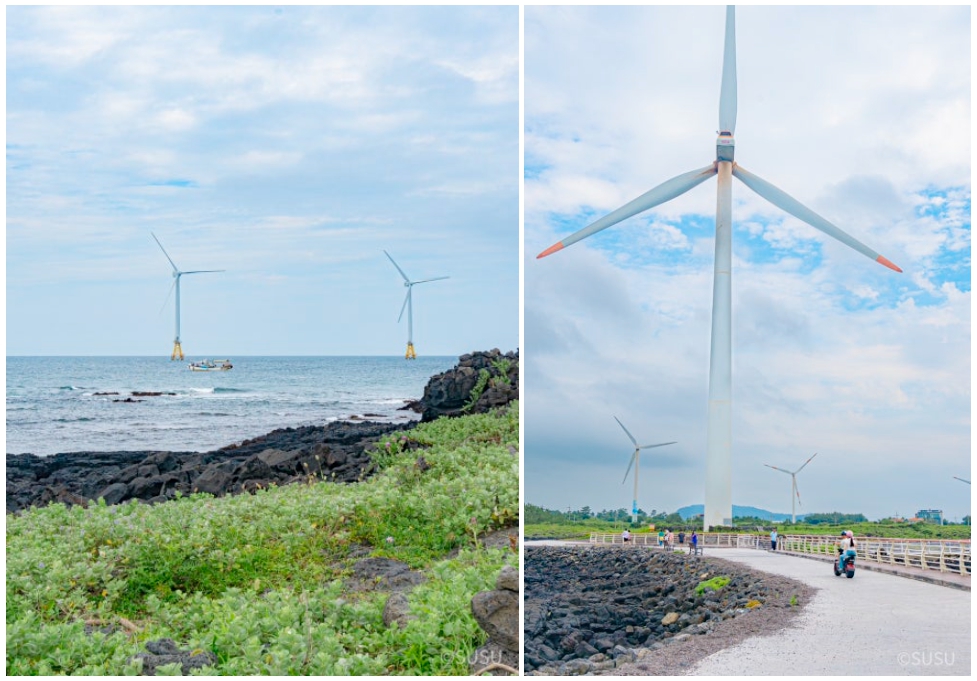
Stop 4 — Sinchang Windmill Coastal Road: The signature stretch of this route — white offshore wind turbines lining the sea
↓ Return route along the same coast
End: Back at Jeju City, ideally before sunset
Why This Route?
Sinchang Windmill Coastal Road (신창풍차해안도로) is the highlight that locals talk about and most tourist itineraries skip. A row of about 10 large offshore wind turbines stands in the sea along a 1.5 km stretch of coast, with a wooden walking path that lets you get up close. The combination of the turbines, the open sea, and on clear days a view of Biyangdo Island just offshore, is one of the more genuinely cinematic landscapes on the island.
There’s a free public parking lot at the entrance (large, rarely full), and a small shop nearby rents electric bicycles if you want to ride the path itself rather than just drive past. Bicycle rental is around ₩10,000 ($7 USD) for 40 minutes.
Geumneung Beach (금능해수욕장) is the other highlight worth a longer stop. Smaller and quieter than Hyeopjae next door, it has clear shallow water, a wide sandy stretch, and the famous “Geumneung ♥” sign drawn in black volcanic stones — one of the most photographed spots on Jeju’s west coast. In summer it’s crowded with swimmers; in spring and autumn it’s nearly empty and ideal for a quiet break.
Multi-Day Trip Planning
If you’re staying longer than a day:
2 days, 1 night: West coast on day 1 (route above), south coast (Seogwipo, Jusangjeolli, Cheonjiyeon Falls) on day 2.
3 days, 2 nights: Add the east coast (Seongsan Sunrise Peak, Udo Island, Manjanggul Cave) for the third day. This is the sweet spot for circling the entire island.
4 days, 3 nights: Add Hallasan area (Korea’s tallest mountain) and the inland mid-mountain (jungsangan) routes. Ideal pace if you want to actually stop and enjoy spots rather than just drive through them.
Most riders agree 3 days is the right amount — long enough to see the whole island, short enough that you don’t get tired of riding.
Safety Tips for Jeju Scooter Riding
Wind: Jeju is famously windy. Coastal roads can have crosswinds strong enough to push a 50cc scooter sideways. Slow down on bridges and exposed sections, especially in winter and early spring.
Sudden rain: Jeju gets sudden downpours, especially during the May–July rainy season and again during typhoon season (August–September). Check the weather before you set out, and don’t ride through a typhoon.
Helmet enforcement: Korean police actively enforce helmet laws. Fines start at ₩20,000 ($15 USD) and can be much higher with a passenger. Always wear it, even on short rides.
Drinking and riding: Korea has a strict 0.03% blood alcohol limit. A single beer can put many people over. The penalties are severe and apply to scooters as well as cars.
Side roads: Outside main tourist routes, smaller roads can have loose gravel, sudden potholes, or chickens. Stay alert and ride slowly through villages.
Planning a broader Korea trip beyond Jeju? Our Korea travel tips guide for 2026 covers SIM cards, T-money transit, navigation apps, and other essentials for international visitors.
Can I rent a scooter with just my home license?
No. You need the 1968 Vienna Convention IDP with Category A endorsement, plus your home license, plus your passport. All three are required.
When should I get the IDP?
Before you leave your home country. Apply at least a week before your trip, in case it needs to be mailed. Korean authorities cannot issue an IDP to foreign tourists already in Korea.
Is it safe for beginners?
Yes on coastal roads, but practice in a parking lot for 20–30 minutes first if you’re not confident. The main coastal roads are well-maintained and traffic is light by Asian standards. Complete beginners should consider an automatic 50cc and avoid the city center on day one.
Can I take the scooter to Udo Island?
No. The ferry to Udo from Seongsan does not allow rental scooters. Park at the Seongsan ferry terminal and rent a different scooter or e-bike on Udo itself once you arrive — there are several rental shops at the Udo ferry dock.
Is it cheaper than renting a car?
Yes, significantly. A small car rental on Jeju costs ₩60,000–100,000 ($45–75 USD) per day; a 125cc scooter is half that or less. Fuel is also much cheaper. The trade-off is weather exposure and limited luggage capacity.
What if I have an accident?
Buy the optional insurance — it covers most damage to the scooter. For medical issues, dial 119 (Korea’s emergency number, with English support). Your travel insurance should cover hospital costs. Keep the rental shop’s phone number saved before you leave.
Jeju on a scooter is one of the more memorable ways to travel in Korea — especially if you’re already comfortable on two wheels and want a different experience from the typical city-focused itineraries. The combination of coastline, light traffic, dramatic landscapes, and small distances makes it close to ideal scooter terrain.
The single biggest piece of advice: get the IDP before you fly. Everything else can be figured out on arrival, but that one document determines whether your scooter trip happens at all. Once that’s sorted, the rest is just picking a route, a clear day, and a reliable shop.
License requirements and rental prices verified for April 2026. Korean traffic regulations and IDP recognition policies are subject to change — confirm with your home country’s automobile association before traveling.